The Evolution of Modular Power Distribution in 2025
Discover how modular power distribution units in 2025 redefine scalability, efficiency, and compliance, supporting data centers and renewable energy projects.


+86 15867381241
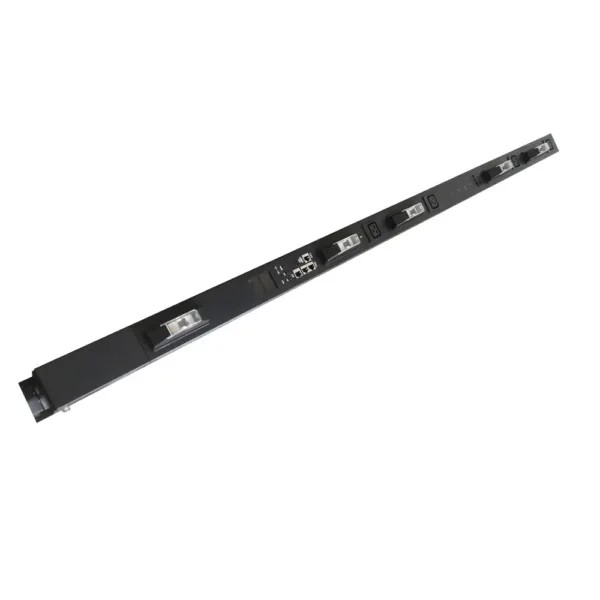
Rack-level power delivery directly impacts uptime, energy efficiency, and the service life of every server in a cabinet — yet it is often overlooked by facility operators. As high-density AI and compute workloads push more load through each enclosure, legacy basic PDUs distribute power but offer almost no visibility into the slow, hidden damage caused by poor power quality. Minor voltage sags and harmonic distortion rarely trigger alarms, but they gradually shorten equipment lifespan and waste energy. A cabinet can draw steady-looking current while feeding distorted power back upstream, leaving teams reacting to failures instead of preventing them.
Innovative intelligent PDUs close this gap with built-in power quality monitoring and diagnostic features, turning invisible problems into measurable, addressable issues. This guide breaks down why rack power quality matters, where legacy PDUs fall short, and which modern features deliver the most reliability value.
Good rack power quality reduces energy waste, lowers maintenance and replacement costs, and improves overall system reliability. Harmonic currents propagate through the entire electrical system, causing transformers, conductors, and wiring to run hotter. Elevated temperatures accelerate insulation degradation and shorten IT equipment service life. Severe waveform distortion can also cause nuisance breaker trips that cut power to critical systems with no actual fault, and trigger random crashes or resets on sensitive electronics.
Nearly all of this damage happens gradually, with no visible warning until equipment already fails. Over time, harmonics also degrade power factor, increasing utility costs and system losses. The effects cascade into cooling systems as well: uneven heat output causes inconsistent airflow, which leads to thermal throttling, lower performance, and eventually unplanned downtime. Because power and cooling are tightly coupled, a fault in one quickly degrades the other. This is why power quality issues must be addressed at the cabinet level, not only at the building service entrance.
High-density compute has completely rewritten rack power requirements. Traditional enterprise racks draw 7–10 kW; modern AI racks pull 30–100+ kW per enclosure, placing unprecedented stress on facility architecture, cooling, and the power grid. AI workloads are also highly bursty: large GPU clusters can swing load by hundreds of kilowatts in seconds, and the low-inertia power-electronic interface of these systems introduces significant harmonic distortion.
| Factor | Effect on Power Quality Strain |
|---|---|
| High power density | Extreme per-rack load strains facility electrical architecture and upstream infrastructure |
| Fast workload variability | Bursty GPU loads cause sharp, rapid power fluctuations |
| Power-electronics interface | Low-inertia converters introduce elevated harmonic distortion |
Sufficient capacity alone is no longer enough. Operators must match high-density rack PDUs to the facility’s electrical infrastructure. A standard PDU built for low-density loads may deliver current reliably, but will provide zero visibility into the distortion passing through it. Aligning PDU capabilities to actual load profiles keeps rack power distribution predictable as density scales.
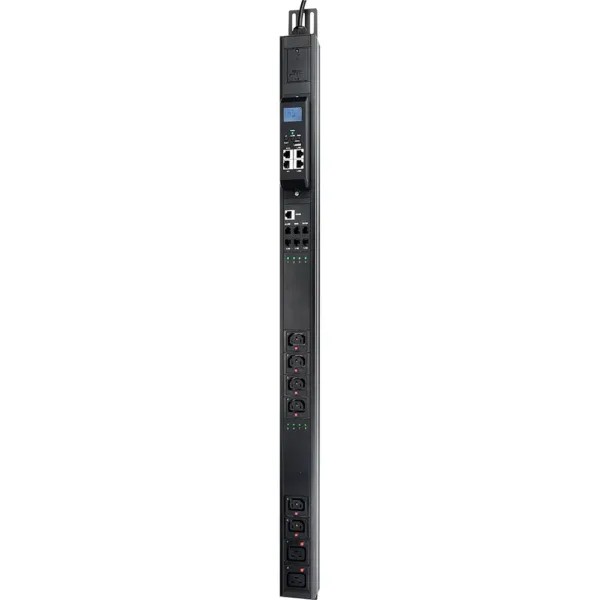
A basic rack PDU reliably routes incoming power to each outlet, but that is the full extent of its capability. Unmonitored units have no built-in metering and no network connectivity, so no consumption data reaches DCIM or building monitoring systems. This creates a permanent blind spot in the power chain.
Operators are forced to plan capacity based on estimates, with no view of true rack-level load and no way to know how much safety margin remains before a breaker trips. Legacy hardware also typically lacks support for modern protocols such as SNMP, Modbus TCP, or BACnet, so it cannot integrate into digital operations workflows.
| Blind Spot in Basic PDUs | Operational Consequence |
|---|---|
| No metering or network communication | No power data flows to DCIM; permanent visibility gap |
| No rack-level true load visibility | Capacity planning relies on guesswork |
| Undetected power quality problems | Equipment lifespan degrades unnoticed |
| No modern industrial protocols | No path to digital monitoring integration |
Basic PDUs remain appropriate for simple, low-density deployments with stable loads, such as small server rooms. Demanding data center environments require feature-rich PDUs that monitor both power delivery and power quality at the device or cabinet level.
Basic metering only reports total current draw — it says nothing about the shape of that current. Harmonic distortion hides inside the waveform, passing completely untouched through a legacy PDU. Operators only discover the problem after equipment fails or a breaker trips for no obvious reason.
Modern dense, bursty loads generate far more of this hidden distortion than legacy IT equipment. Feature-rich PDUs capture full waveforms and track total harmonic distortion at the cabinet, turning an invisible problem into a measurable one. Teams can then trace the source and correct it before damage accumulates.
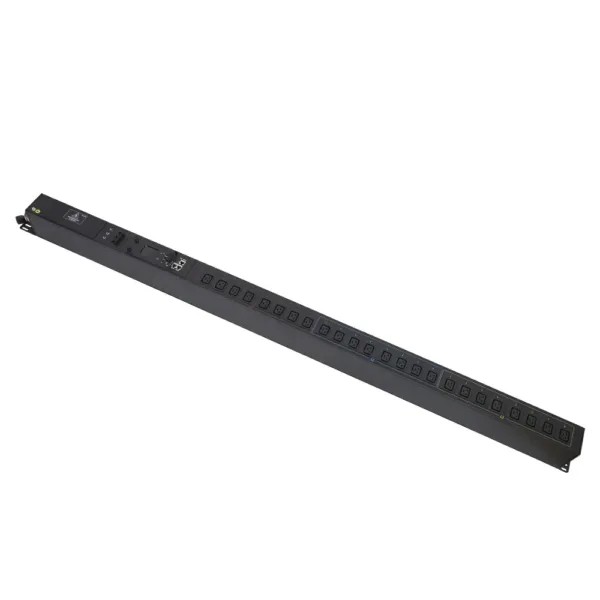
While basic metering provides only a single current number, waveform capture records full electrical conditions before, during, and after a disturbance. Operators can study anomalies, verify actual power quality performance, and dramatically speed up root-cause analysis after an event. Advanced units also include ITIC curve plotting, which maps voltage tolerance events against industry standard limits to help teams assess severity and likely impact on connected equipment.
Total harmonic distortion (THD) monitoring adds continuous, quantitative tracking of waveform quality. Uncontrolled distortion threatens the resilience of critical IT systems, so ongoing monitoring and preventative maintenance are essential for reliability. Continuous data logging preserves measurements through transient events, and real-time alarms flag voltage sags, surges, and overloads before they escalate into failures.
A breaker trip usually kicks off a long investigation. Trip forensics shortens it dramatically. Enhanced circuit breaker trip forensics identify exactly which outlet and device caused the trip, displayed directly on the PDU web interface and controller LCD. Waveform capture can trigger automatically when an overcurrent protective device trips, recording voltage and current at the exact moment of the event.
When a power supply fails, rack-level waveform data often reveals an inrush current surge as the root cause. This eliminates hours of guesswork and lets teams resolve issues faster, with less downtime.
Intelligent PDUs deliver rack- and outlet-level visibility that conventional units cannot, and integrate with DCIM platforms via standard protocols including Redfish, JSON-RPC, and SNMP.
This granular data unlocks three key operational improvements:
Power quality describes how clean and stable the electrical supply is. At the rack, it covers voltage stability, harmonic distortion, and phase load balance. A cabinet can have a steady-looking total current while still introducing harmful distortion upstream. Rack-level monitoring makes these conditions visible.
Basic amperage metering only reports total current, not waveform shape. Waveform capture and THD monitoring record the actual current and voltage shape, revealing distortion and anomalies that basic readings miss. Continuous logging and real-time alarms then flag sags, surges, and overloads before they cause damage.
Yes. Basic units work well for simple, low-density rooms with stable loads. Metered units add usage visibility, smart units add remote control, and heavy-duty units handle dense high-current loads. Each tier serves a distinct role across a data center fleet.
Start with the load profile and the facility’s electrical infrastructure. Match plug types (10A, 16A, IEC C13, C19, etc.) to the equipment, then decide how much monitoring and remote control the site requires. A structured customization process can help validate the exact fit before production.