


© Copyright – 2010-2023 : All Rights Reserved. Sitemap
Power Distribution Unit PDU, rack mount PDU, PDU data center, Smart PDu, intelligent PDU
Power Distribution Unit PDU, rack mount PDU, PDU data center, Smart PDu, intelligent PDU


+86 15867381241
Three Phase PDU
We are a rack PDU manufacturer. We build three-phase units for 208V, 400V and 480V racks, and we configure the form factor, outlet layout, monitoring tier and protection to the project.
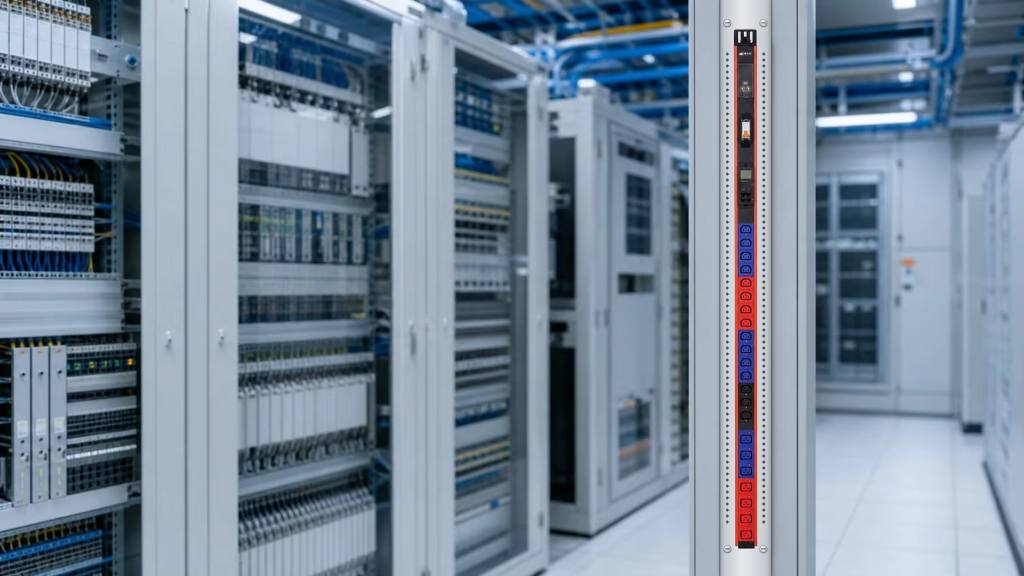
YOSUN manufactures rack PDUs in both phase configurations. This section explains the electrical difference, so a specification starts from the load instead of the outlet count.
Power reaches the rack from a floor box, an overhead busway or a panelboard. A PDU takes 3P+N+E and divides the load across L1, L2 and L3. Each phase carries one third of the total.
A Wye system carries a neutral, so it feeds line-to-line and line-to-neutral loads from one input. A Delta system has no neutral and supplies line-to-line voltage only. The receptacle rating plate names the system; read it before the outlet layout is drawn.
Line-to-line voltage is 1.732 times line-to-neutral voltage. That ratio is why 400V gives 230V, 208V gives 120V and 480V gives 277V. C13 and C19 outlets on an IEC 320 PDU always connect line-to-neutral.
At 32A, a single phase PDU on a 230V feed carries 7.4 kVA. The same 32A on 400V three-phase carries 22.2 kVA, which is three times the capacity on one cable. AI and HPC racks run from 50 kW to 300 kW, so three-phase is the practical choice above 10 kW.
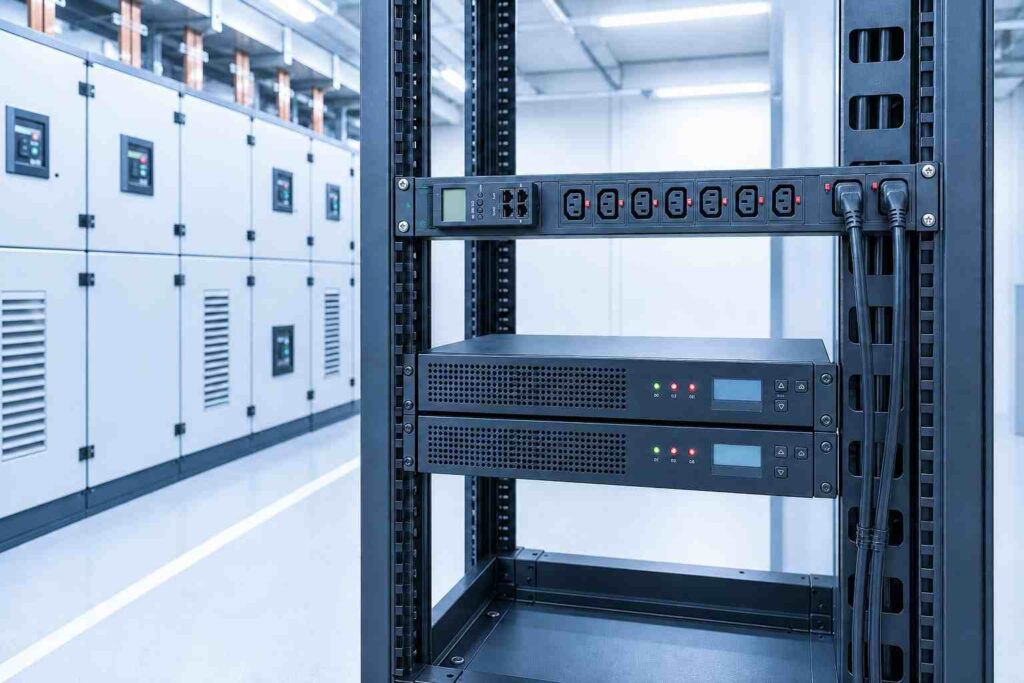
Same current, different capacity
| Feed | Nameplate | Rack it serves |
| 32A · 230V single-phase | 7.4 kVA | Up to 5 kW |
| 32A · 208V three-phase | 11.5 kVA | 5–10 kW |
| 32A · 400V three-phase | 22.2 kVA | 10–18 kW |
| 63A · 400V three-phase | 43.6 kVA | 18–35 kW |
Size the rack from the load, not from the outlet count.
Send the device list or the total kilowatts. We return phase, voltage and amperage in one reply.
We configure the input to the facility, not the other way round. Voltage class, amperage band and plug type are fixed before the outlet layout is drawn.
Voltage, plug standard and certification route by market
| Market | Line-to-line | Line-to-neutral | Typical input | Certification route |
| North America (120/208V Wye) | 208V | 120V | NEMA L21-30P (5-wire) | UL / ETL |
| North America (208V Delta) | 208V | — | NEMA L6-30P (3-wire) | UL / ETL |
| North America (277/480V Wye) | 480V | 277V | Hardwired | UL / ETL |
| EU · UK · Middle East | 400V / 415V | 230V / 240V | IEC 60309 3P+N+E (red 6h) | CE + CB |
| Asia-Pacific | 380V / 400V / 415V | 220V / 230V / 240V | IEC 60309 or local | CE + CB |
| China | 380V | 220V | IEC 60309 / GB plug | CQC / CCC |
North American racks arrive on one of two 208V systems. Delta carries three live conductors and no neutral, so it feeds 208V loads only. Wye adds the neutral and delivers both 208V and 120V from a single input.
European, UK, Middle East and most APAC sites run 230/400V Wye at 50 Hz. The red IEC 60309 6h connector is the standard inlet at this voltage. Outlets deliver 230V line-to-neutral, which is the rating C13 and C19 devices expect.
A 277/480V Wye feed serves hyperscale halls and industrial plants. IT equipment still needs 208V or 230V, so the build includes a step-down stage or 277V-rated loads. These units are hardwired rather than plug-in.
We build four bands: 16A, 32A, 60A/63A and 100A. A 32A 400V feed covers a standard 42U high-density rack at 22.2 kVA. 100A at 400V reaches 69.3 kVA and serves AI and HPC cabinets.
Nameplate kVA is V × A × 1.732 ÷ 1000, and continuous load takes 80% of that figure. A 32A unit therefore carries 25.6A continuously, not 32A. The table below converts every band we build, so the figure is fixed before quotation.
60A is a UL/NEMA rating and 63A is an IEC rating. Shell size, breaker and certificate differ, so a 63A unit will not enter a 60A receptacle. We quote and certify the two as separate products.
Send the country and the target kilowatts.
We return the voltage class, the amperage band and the input plug in one sheet.
Our standard three-phase chassis is 0U vertical. For cabinets without rear post space we build 1U and 2U units to order.


A zero U PDU mounts on the rear posts and takes no rack units. We build 42U, 48U and 58U heights with 24 to 54 outlets. Mounting is tool-less on every 0U chassis.
Shallow cabinets and network racks have no rear post space, so a horizontal PDU sits in a 1U or 2U slot. A 1U chassis carries 12 to 24 outlets. We build these to order; they are not stock items.
Top feed serves overhead tray and busway; bottom feed serves raised floor. Cords are supplied in different thicknesses and lengths. The cord is assembled into the unit, so it is fixed at order stage.
Tool-less brackets fit standard 19-inch posts. In a 600mm cabinet, keep at least 45mm between the post and the side panel. A 360° rotatable outlet panel solves the tightest rear clearance.
Send the cabinet drawing or the cabinet model.
We confirm 0U clearance, bracket type and feed direction before the order is placed.
We supply the input and output as one matched set, so the electrician installs a unit that fits both the receptacle and the devices.
| Socket | Rating | Typical device |
| C13 | 10A / 250VAC | 1U server, switch, PSU |
| C13 locking | 10A / 250VAC | Same, with retention |
| C19 | 16A / 250VAC | Blade server, storage, UPS |
| C19 locking | 16A / 250VAC | Same, with retention |
| C39 (patent) | 16A | Accepts C13 / C19 / C21 / C39 cords |
| 2×C13 · 3×C13 HD | 10A / 250VAC | Grouped outlet block |


An IEC 309 PDU uses the red 6h connector, rated 380–415V three-phase. Five pins give line-to-line and line-to-neutral output; the four-pin 3P+E version has no neutral. 16A, 32A and 63A use different shell sizes.
A NEMA PDU on L6-30P is 250V, three-wire and delivers 208V only. L21-30P is 120/208V five-wire and feeds 120V outlets. L22-30P serves 277/480V systems.
Above 60A we fit a terminal block or junction box instead of a plug. The module range covers terminal blocks to 32A, 3P junction boxes to 63A, and 100A/125A boxes. A licensed electrician makes the final connection.
We identify the plug from a photograph and the rating plate. The range covers twelve regional standards, from NEMA and BS 1363 to Schuko, French, Australian, Indian and Anderson, so a UK PDU or a Schuko PDU ships as a standard build. The plug is confirmed before the outlet layout is drawn.
C13 takes 10A at 250V and C19 takes 16A at 250V. A common three-phase mix is 30× C13 plus 6× C19. Blade servers and storage shelves need more C19 than 1U servers do, which is why a high density PDU reaches 54 outlets.
Divide the outlet count by three to get outlets per phase. We fit 1P, 2P or 3P breakers from C10 to C63 according to the load mix. Colour-coded sockets make the phase visible at the rear of the rack.
Send a photo of the receptacle and the device list.
We return one matched I/O sheet: input plug, outlets per phase and breaker layout.
We build four intelligence tiers on one chassis platform. A project moves from basic to switched without a mechanical redesign.
A basic PDU distributes power and carries no meter. It suits stable loads where the upstream breaker provides the protection. We build three-phase basic units from 24 to 48 outlets.
A metered PDU shows voltage and current on a local V/A meter. The hot-swap version lets a technician replace the meter while the rack stays live. A metered input PDU meters at the inlet, which matches a single-feed three-phase rack.
A metered by outlet PDU measures every socket separately at ±1%. Colocation operators use this tier to recharge tenants per outlet. The record is granular enough to act as a billing document.
A monitored PDU adds a network port and reports over Modbus, SNMP v1/v2c/v3, HTTP/HTTPS, MQTT and TELNET/SSH. One SNMP PDU chain carries up to 64 single-phase or 247 three-phase units. Monitoring is read-only, so it cannot reboot a server.
A switched PDU adds per-outlet on/off control and power sequencing. Sequencing sets the power-up order so inrush current does not trip the breaker. Locking sockets keep a cable from being pulled out during service.
A dual input PDU gives each server two independent sources from A and B feeds. A maintenance bypass PDU moves load between UPS and utility without a shutdown. Hot-swap controllers are replaced while the rack stays live.
| Tier | Data available | Action available | Buyer |
| Basic | None on the unit | Distribute power | Stable, cost-driven load |
| Metered | Total V / A on local display | Read load at the rack | Small and mid-size rooms |
| Metered-input | Inlet V / A per feed | Read per-feed load | Single-feed three-phase rack |
| Metered-by-outlet | V / A / kWh per socket at ±1% | Bill per outlet | Colocation, multi-tenant |
| Monitored | Unit and outlet data over network | Read, alert, integrate to DCIM | Remote and unmanned sites |
| Switched | Same as monitored | Switch and reboot per outlet | 24/7 operations teams |
Metered, monitored or switched — the price difference is real.
We quote all three at the same kVA and outlet count, so the choice is made on data, not on adjectives.
Datasheet, sample, or a quote for a rollout.
Samples take a few weeks. Bulk production runs 30–45 days.
We configure by application. Rack density decides the build more than the industry label does.

AI racks run from 50 kW to 300 kW. A 100A 400V feed delivers 69.3 kVA nameplate and 55.4 kVA continuous. We size the upstream UPS and busway together with the PDU.
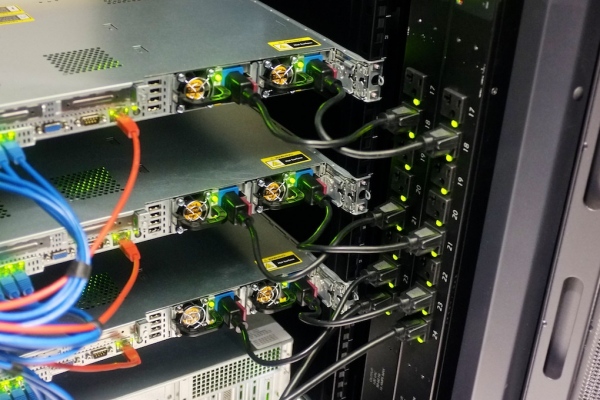
An enterprise rack draws 5 to 15 kW. A data center PDU with a 32A 400V feed covers that range with headroom. Below 5 kW we build the single-phase version at a lower cost.

Tenant billing on a colocation PDU depends on per-outlet data at ±1%. We build each socket with its own record, so a shared rack produces a defensible invoice per tenant. Multi-tenant halls specify this tier as standard.

A crypto mining PDU runs at continuous full load, so the build is sized on the continuous rating rather than the nameplate. A universal PDU accepts the mixed plugs that arrive with miners. We quote these projects with the duty cycle stated in writing.
Tell us what you are building.
We send a reference configuration from a comparable environment, with the reason behind each choice.
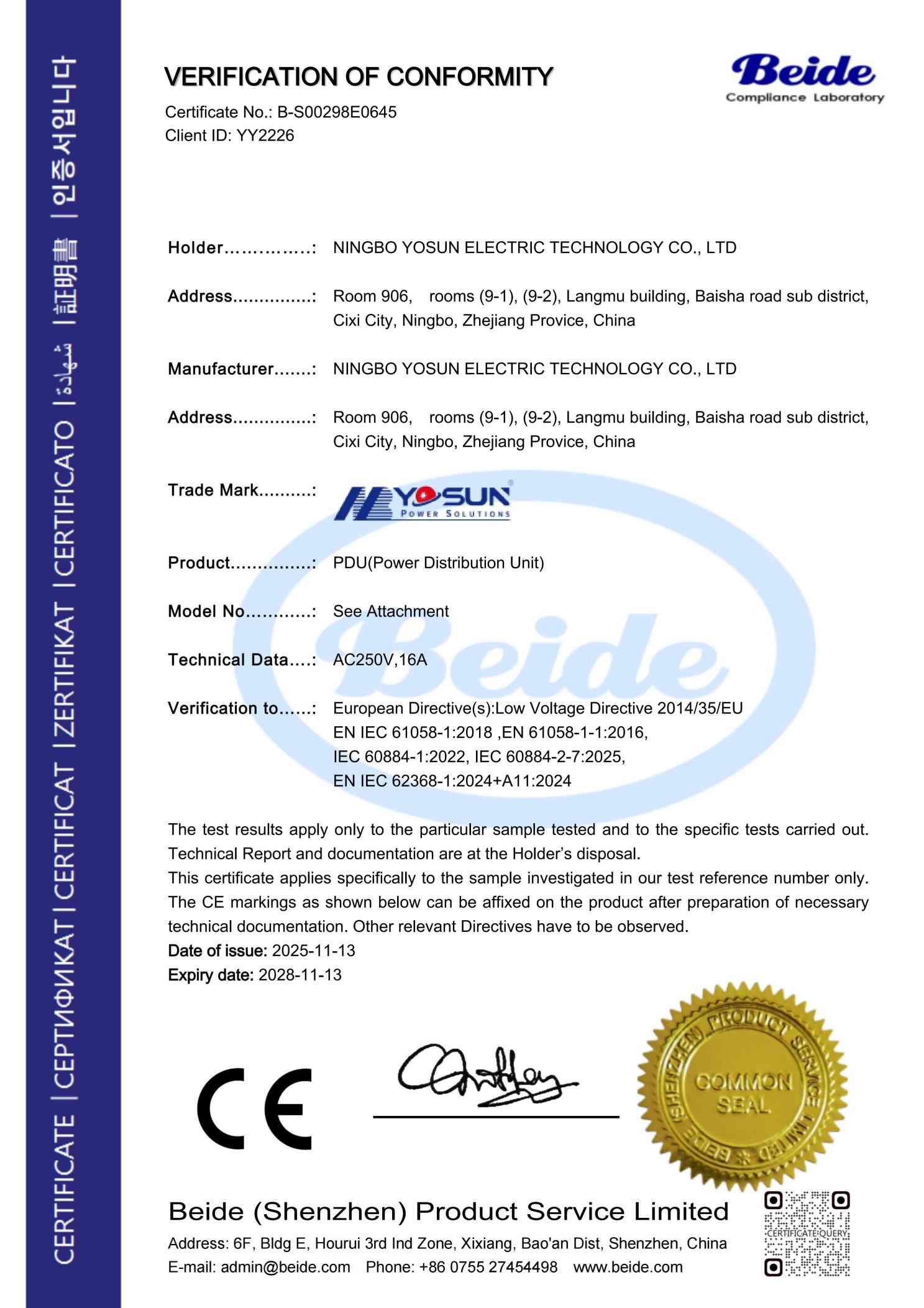
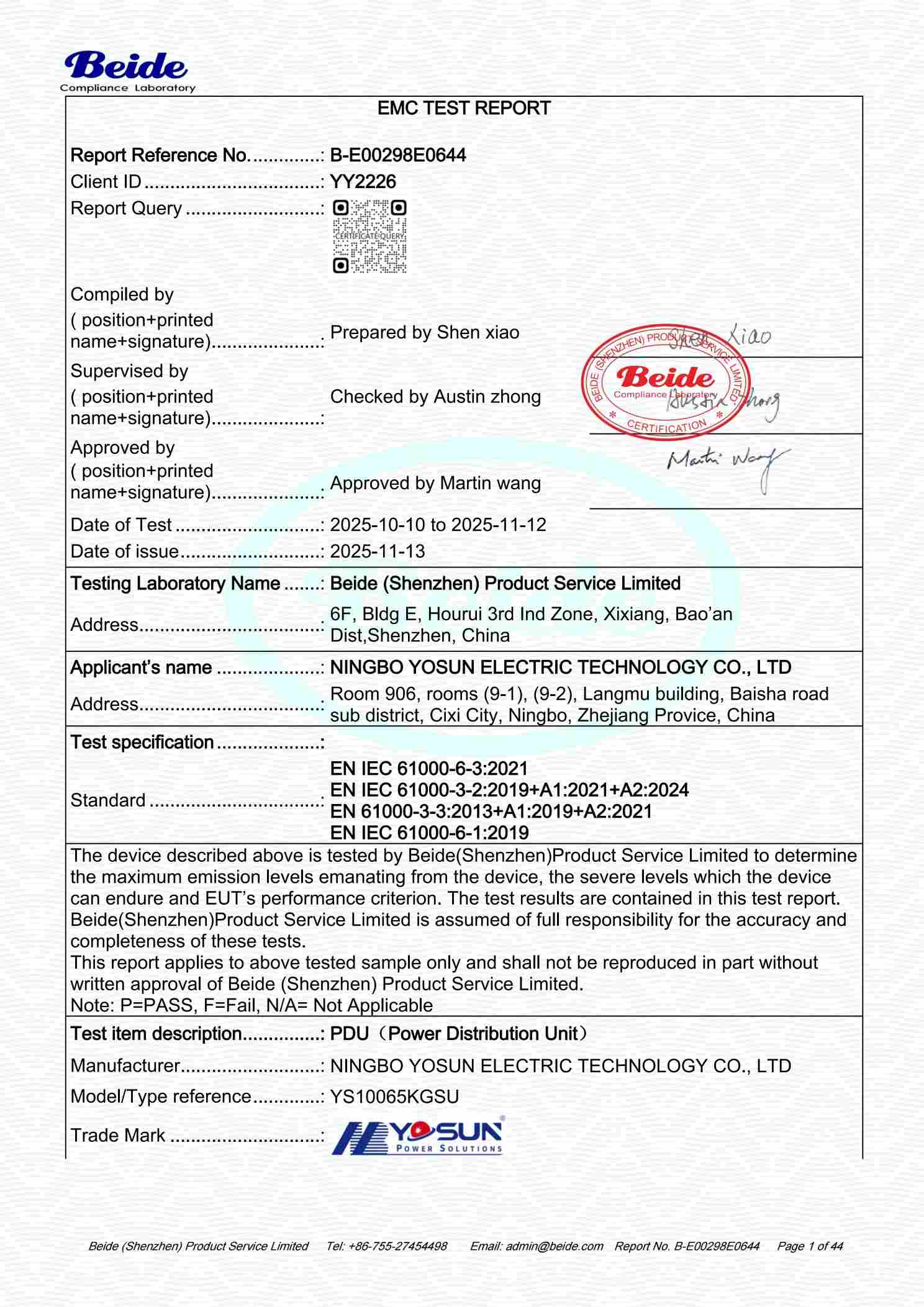
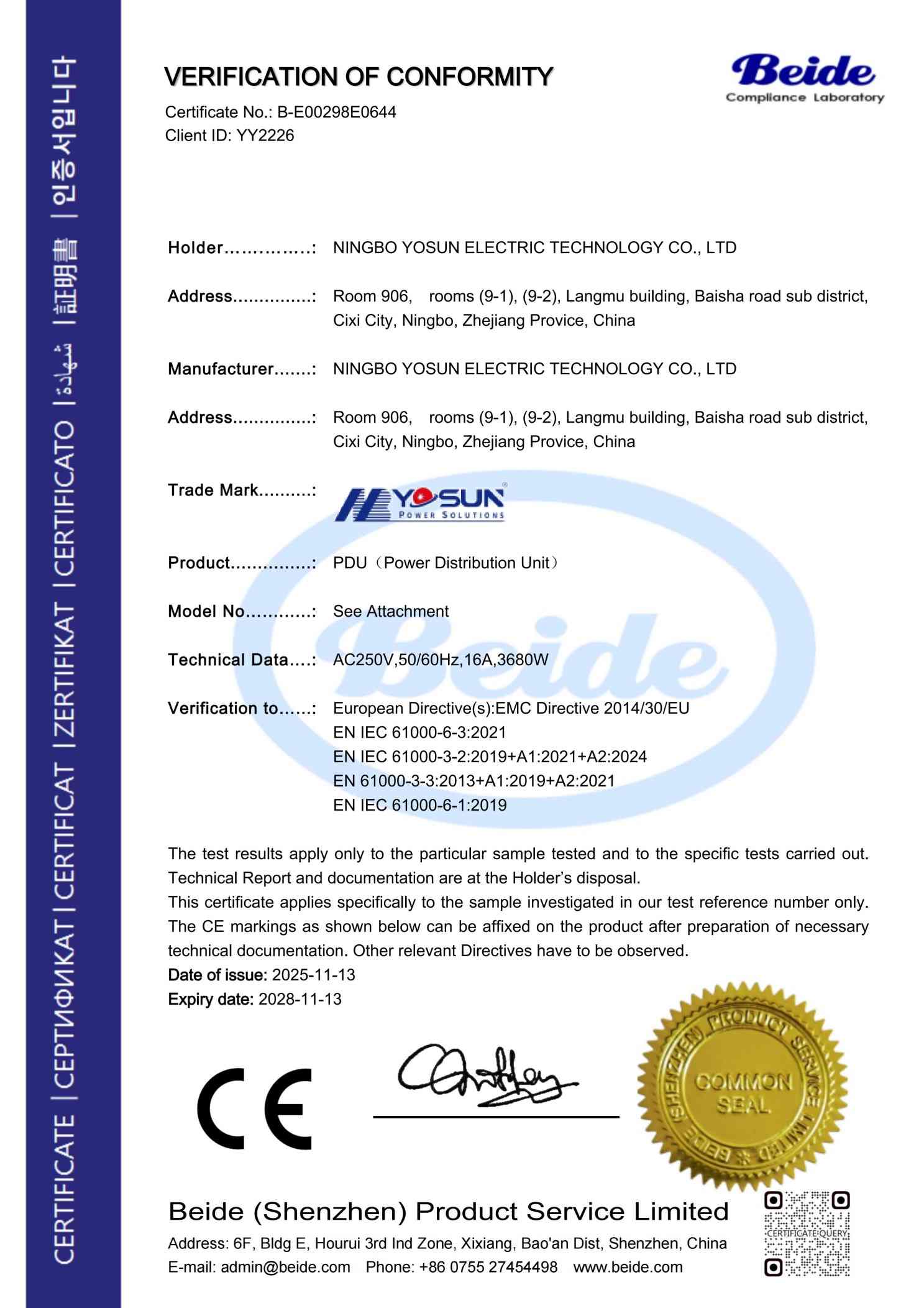
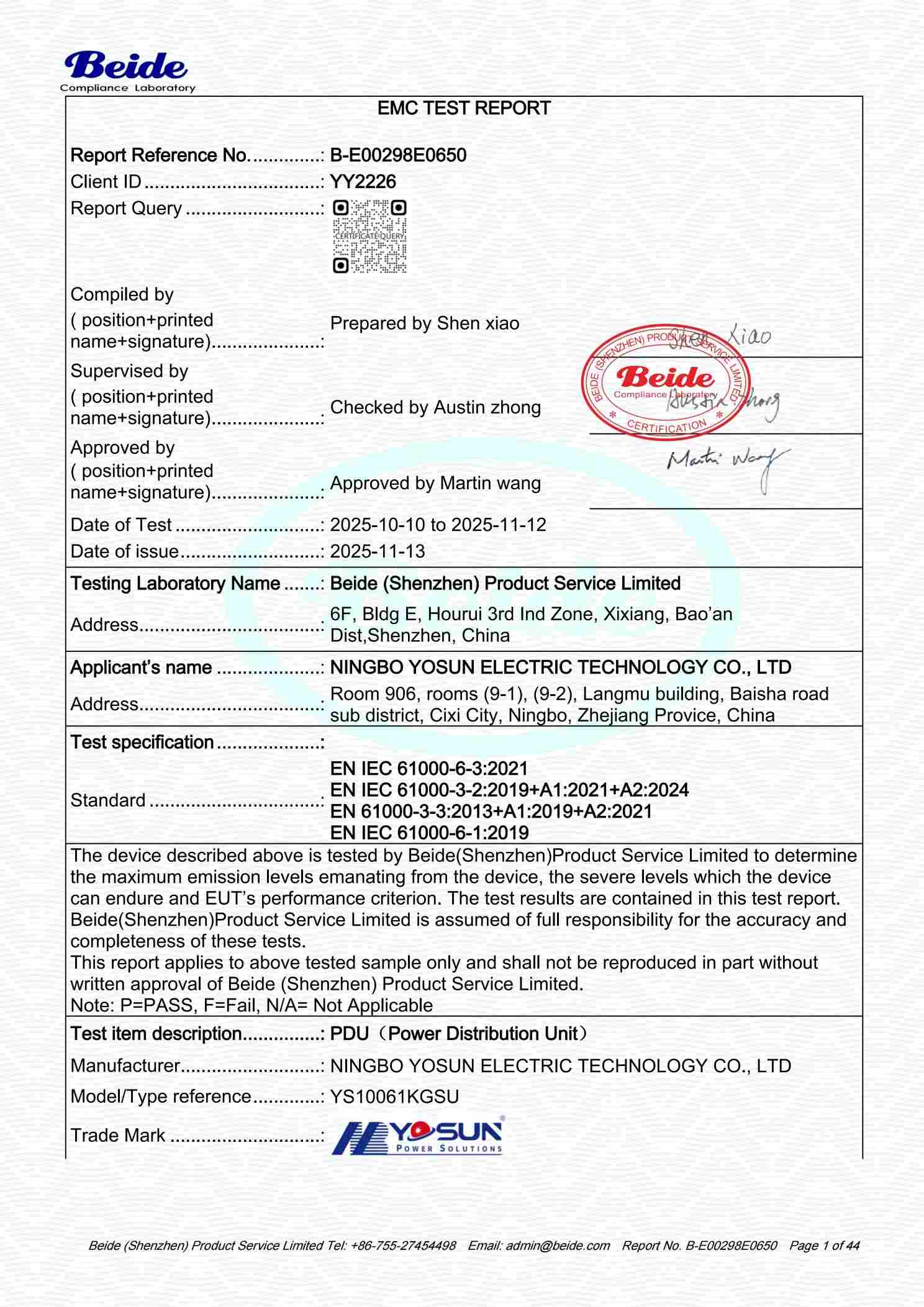
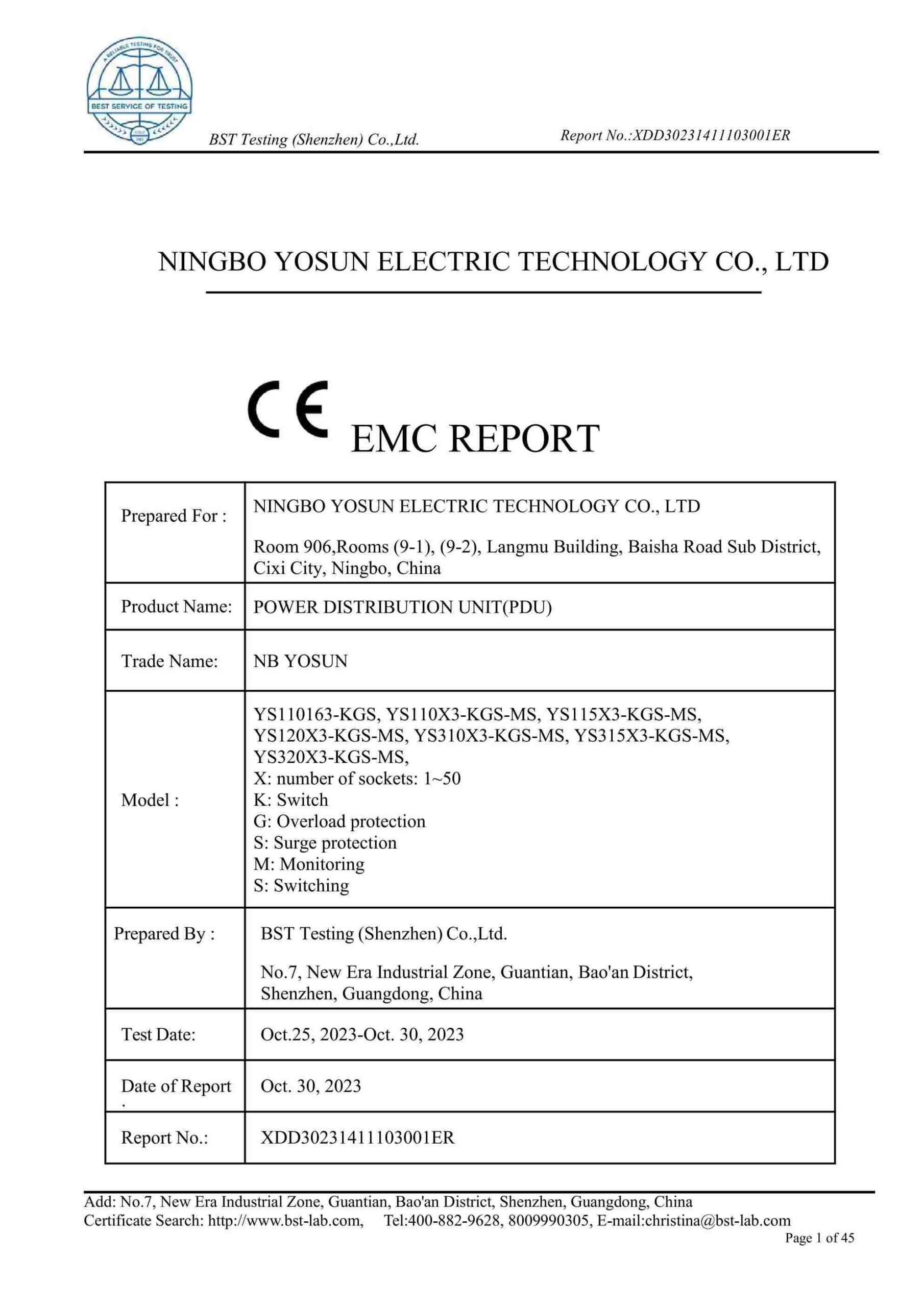
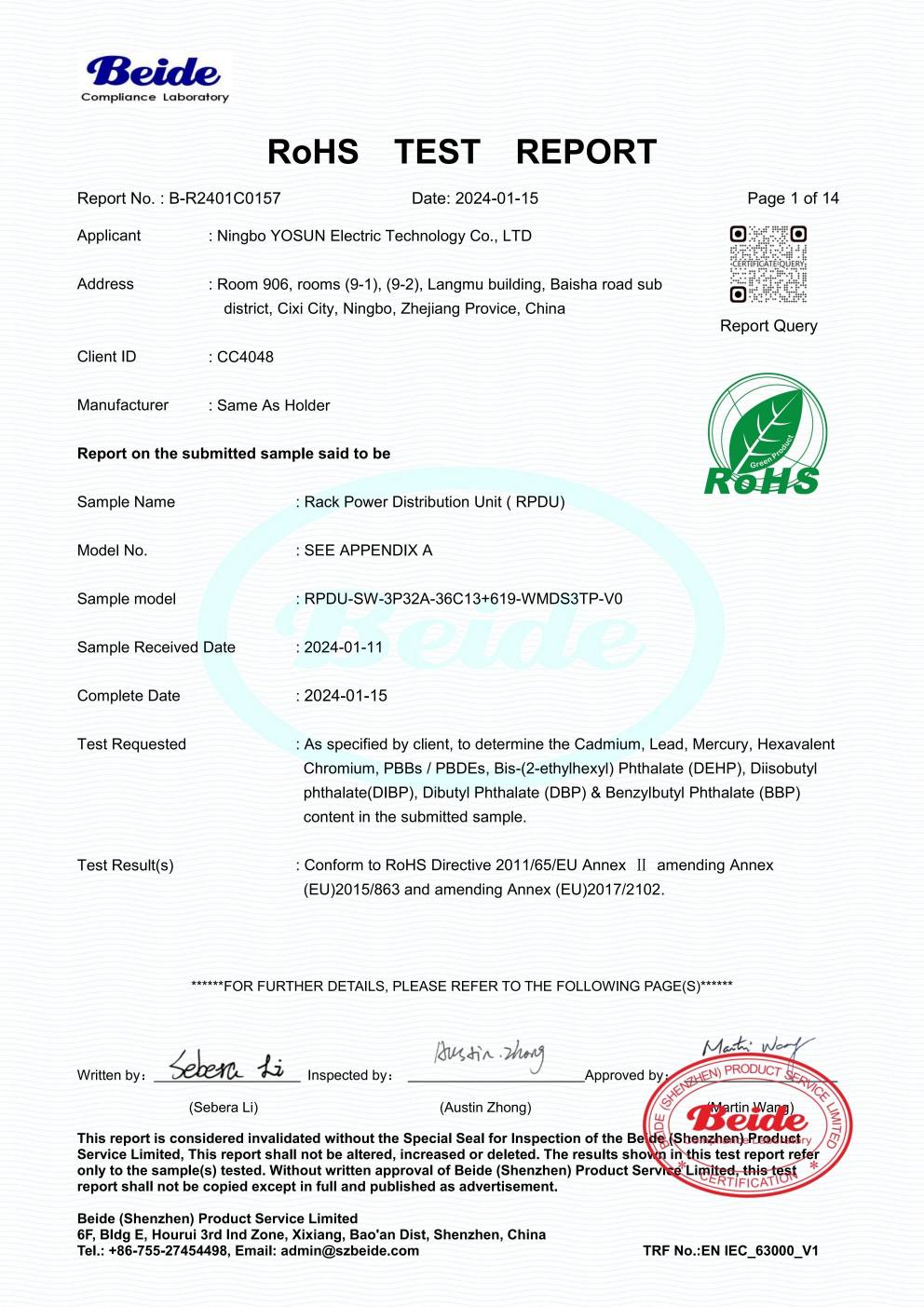
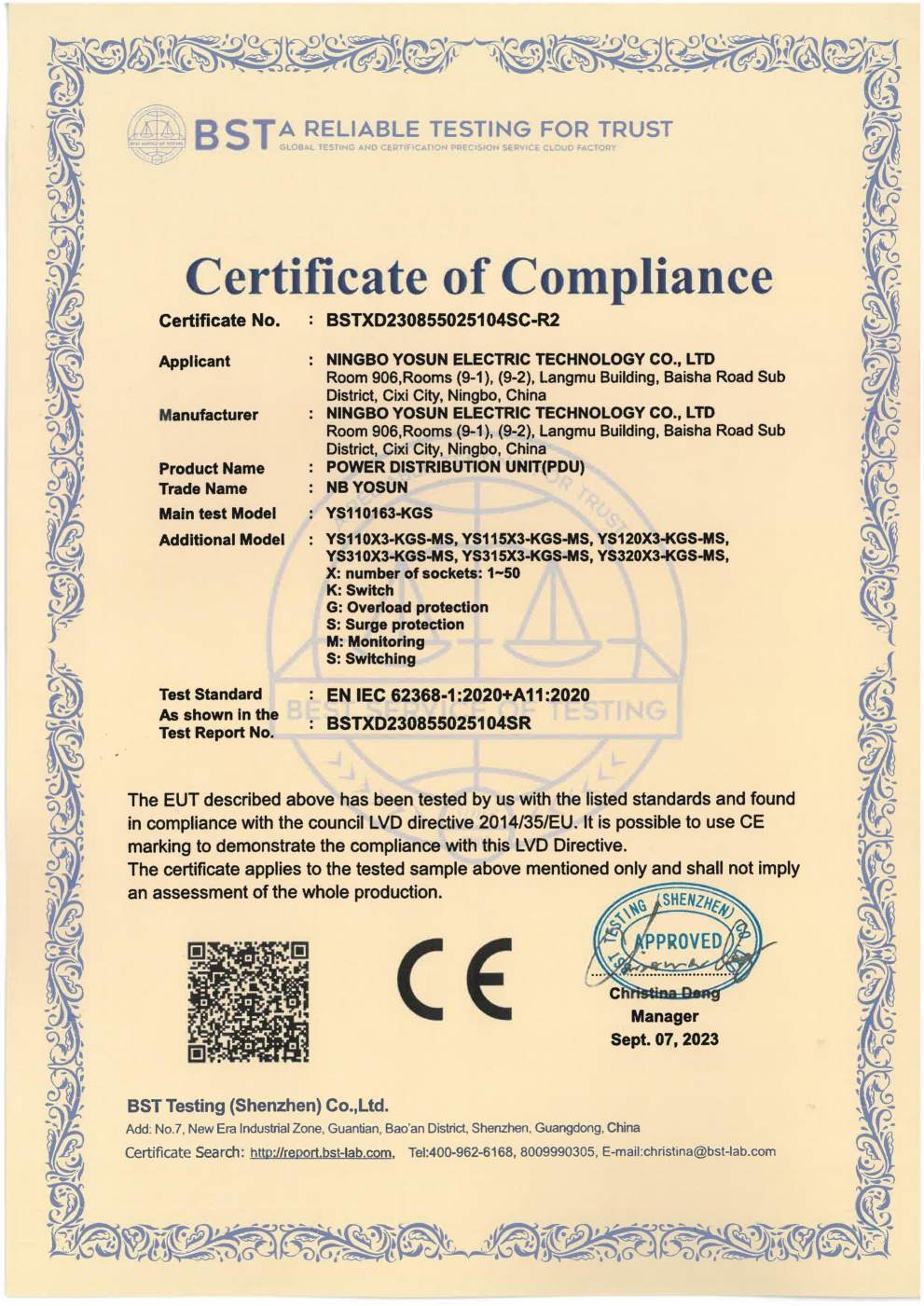
We deliver certification as a per-model, per-market document set, shipped with the hardware.
Core intelligent and three-phase models are certified to UL 62368-1. We issue the certificate number and the test report for the exact model. ETL listing covers buyers who do not specify UL.
CE covers the LVD and EMC directives, with RoHS compliance alongside. CB reports support multi-country registration for 400V and 415V builds. A TÜV factory audit is not TÜV product certification, and we do not present it as one.
CCC and CQC cover the domestic Chinese market. RoHS and REACH declarations ship with EU-bound orders. For Australia, New Zealand, India, Japan, Brazil and Saudi Arabia we register the model through the local scheme per order.
Every shipment carries the datasheet, certificate reference, test report and declaration of conformity. Installation and interface information goes to the electrician. The document pack is issued at quotation stage, before the purchase order.
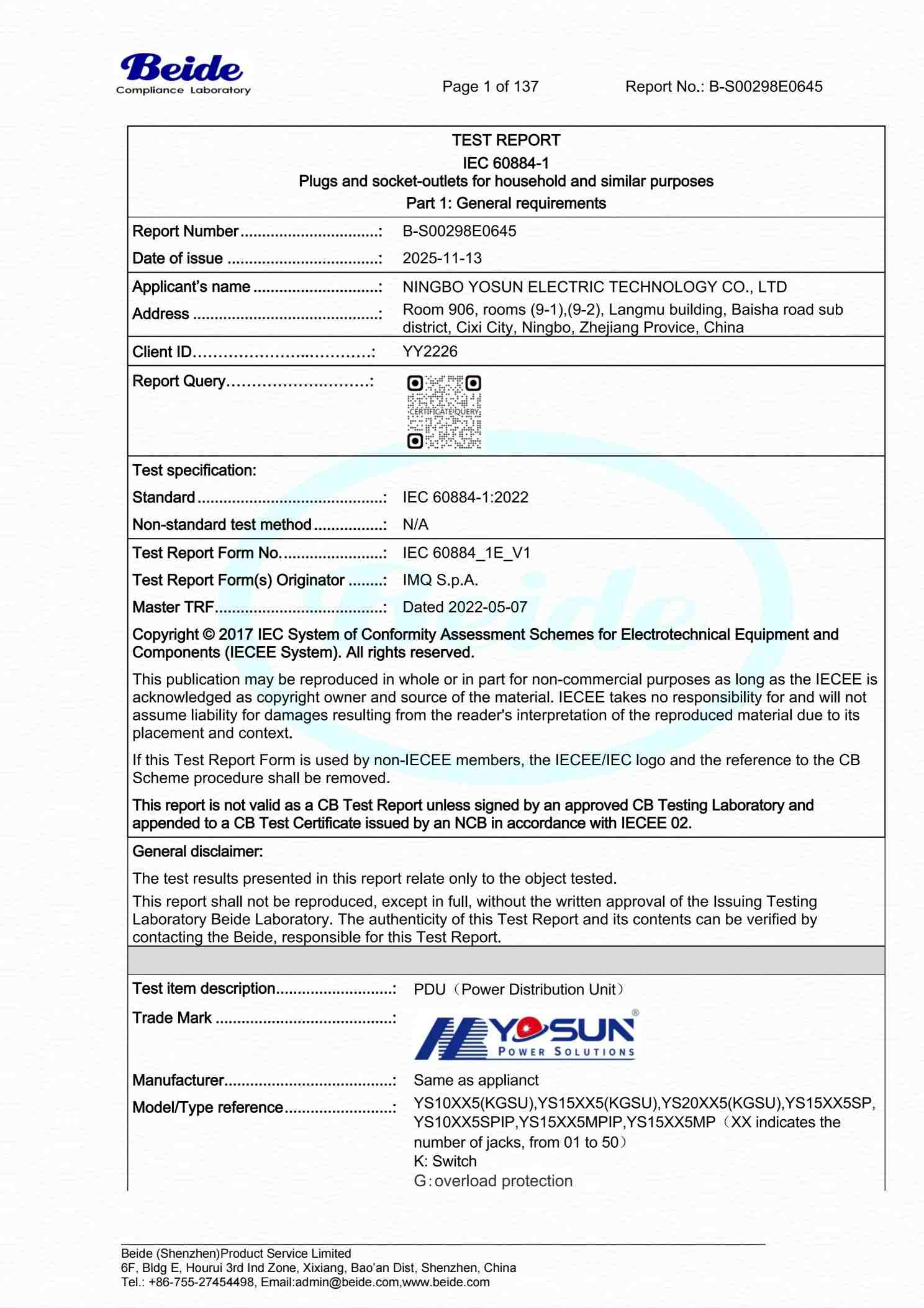

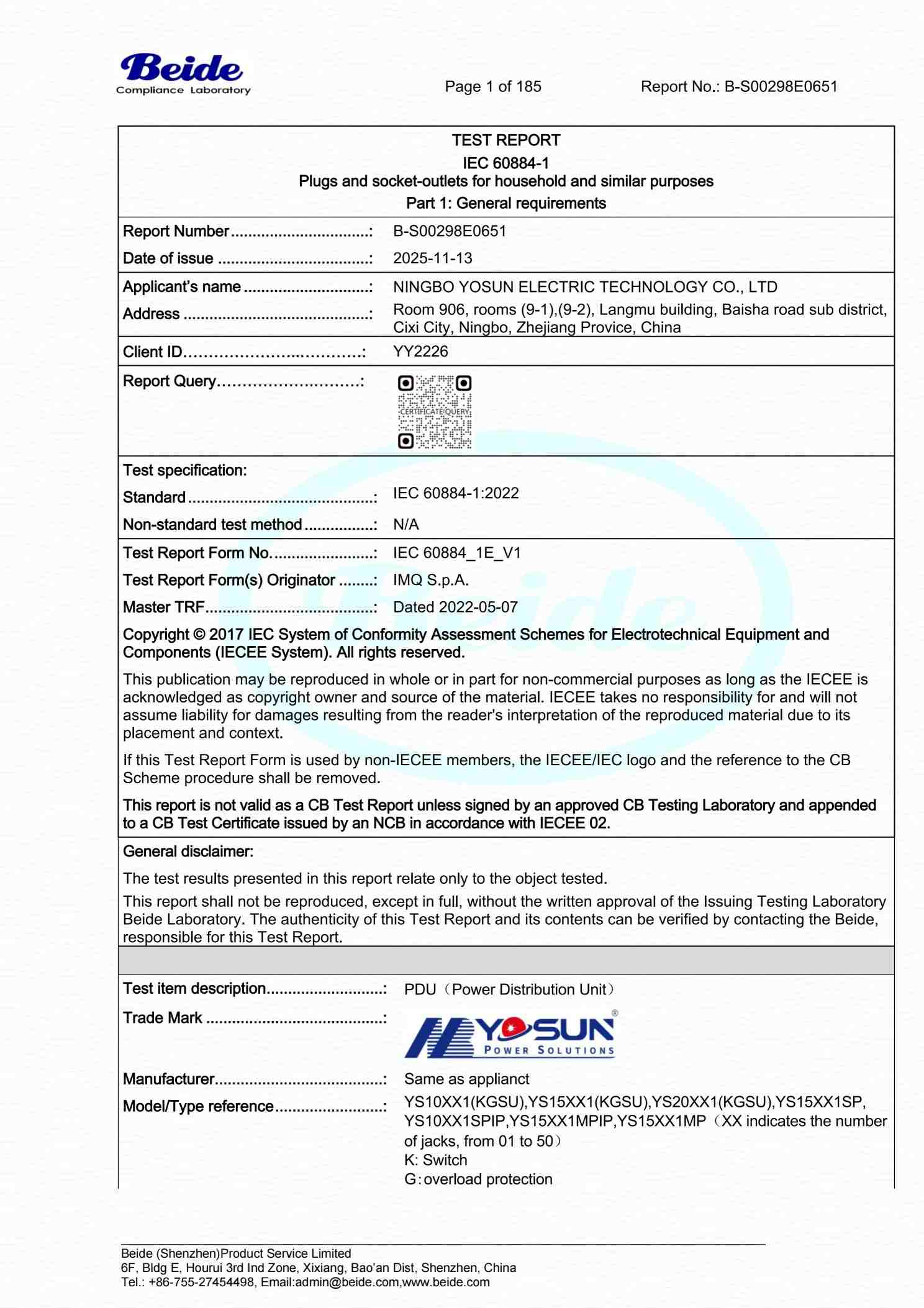
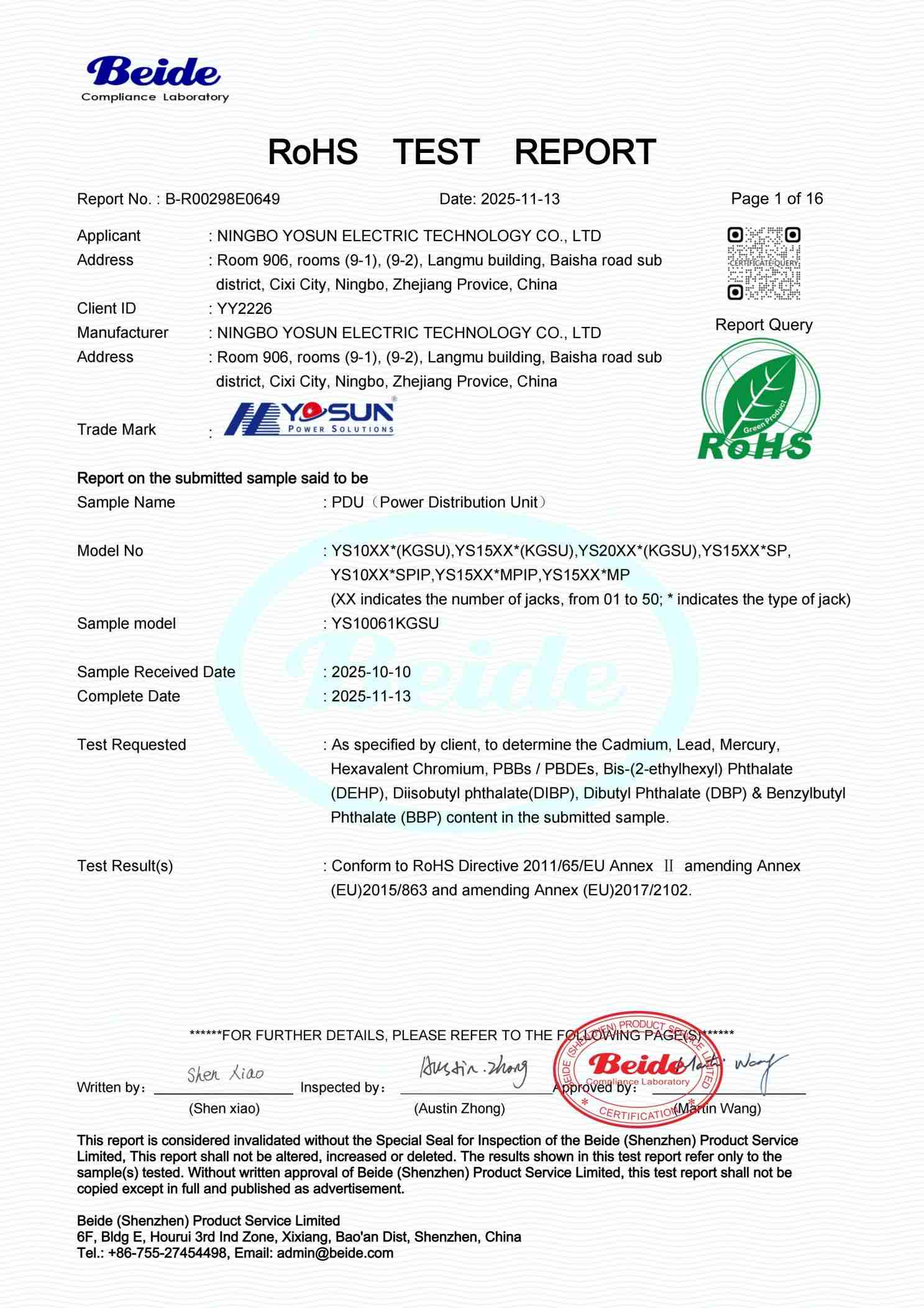
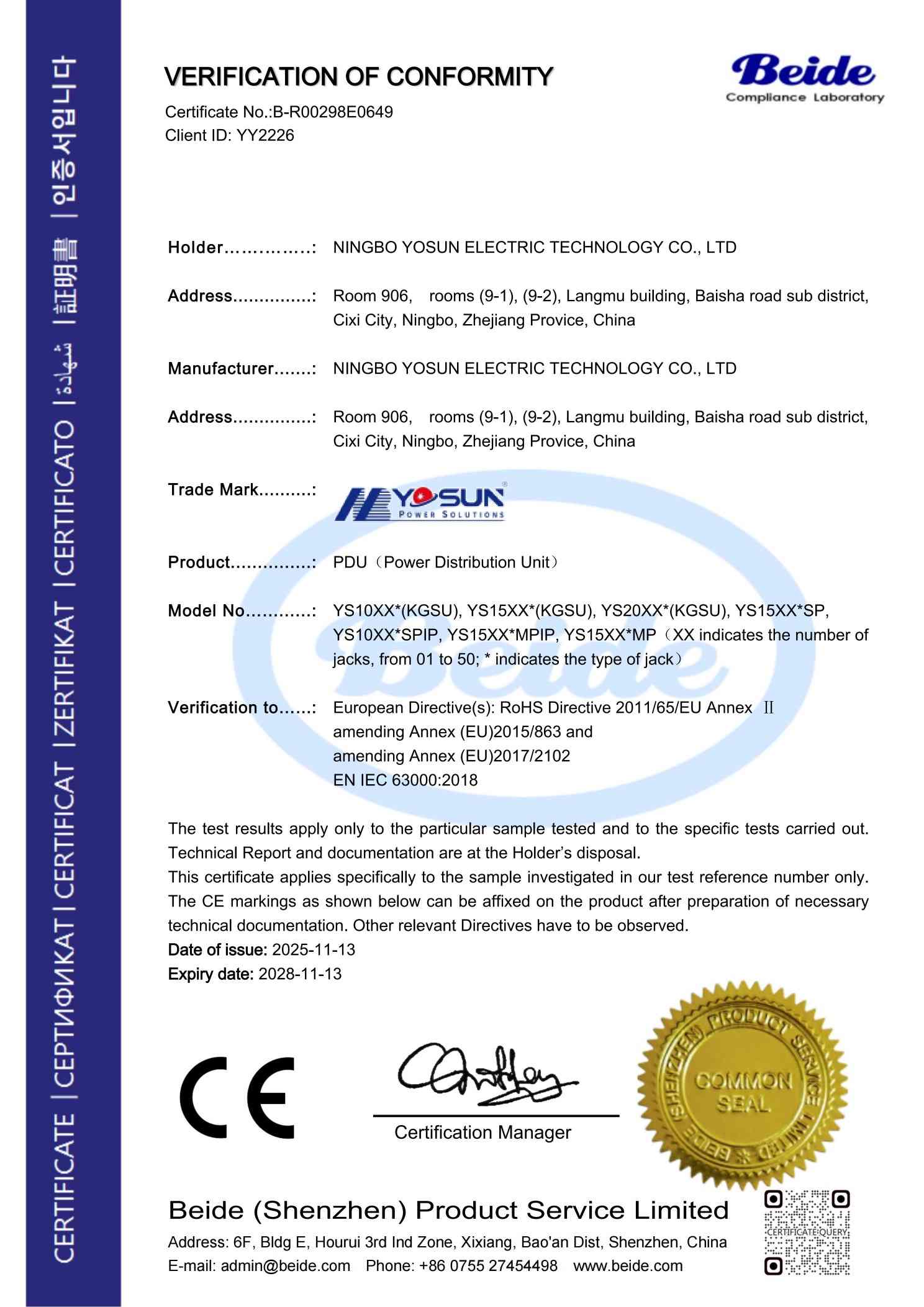
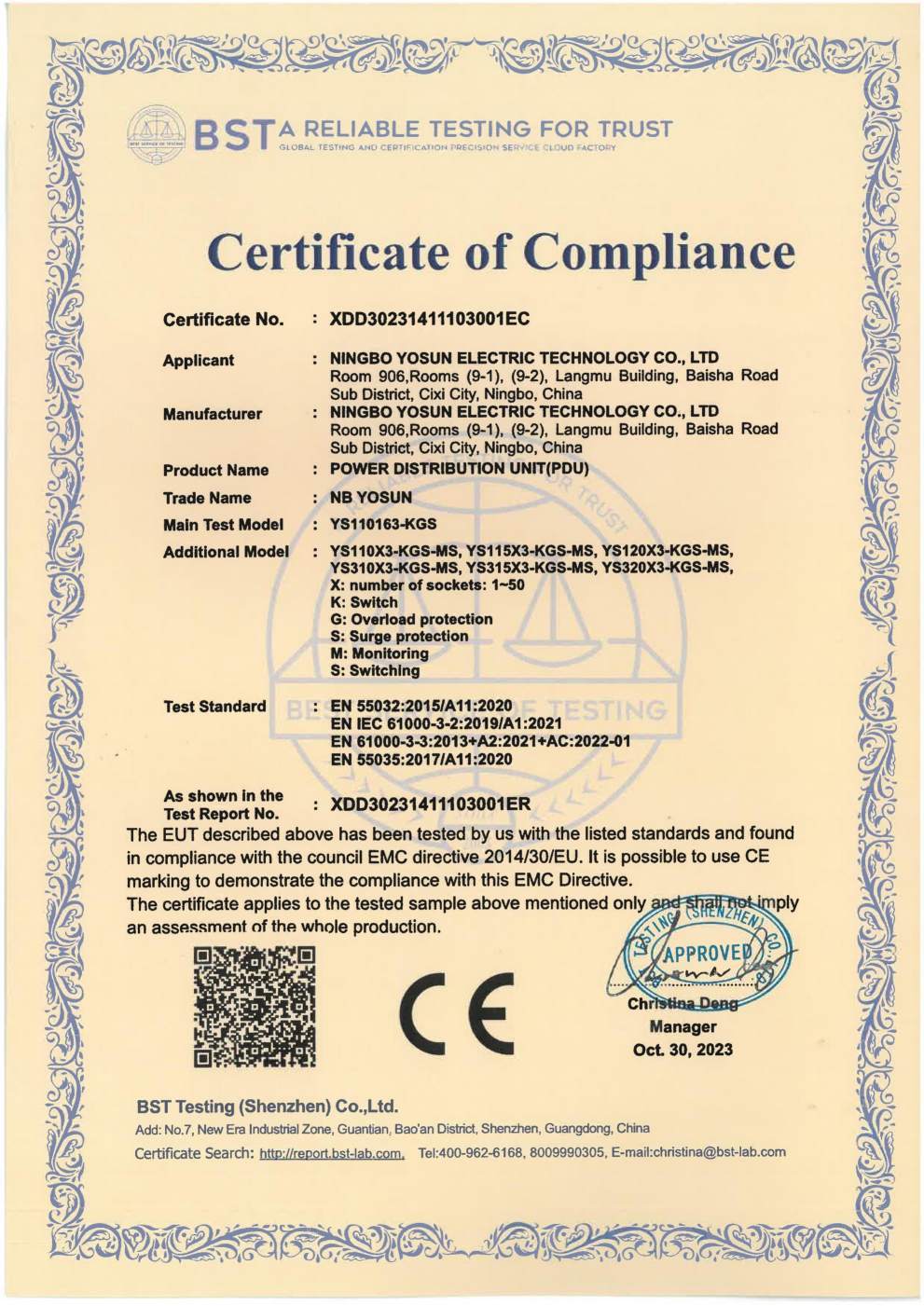

Tell us the destination country.
We send the certificate pack for that model and that market, not a general brochure.
We are a manufacturer, not a trading desk. Tooling, injection moulding, assembly and test run in one plant.
YOSUN has built power distribution products for more than 20 years. Six assembly lines run alongside in-house injection moulding and laser processing. Housing colour and outlet blocks are made on site, which shortens a custom build.
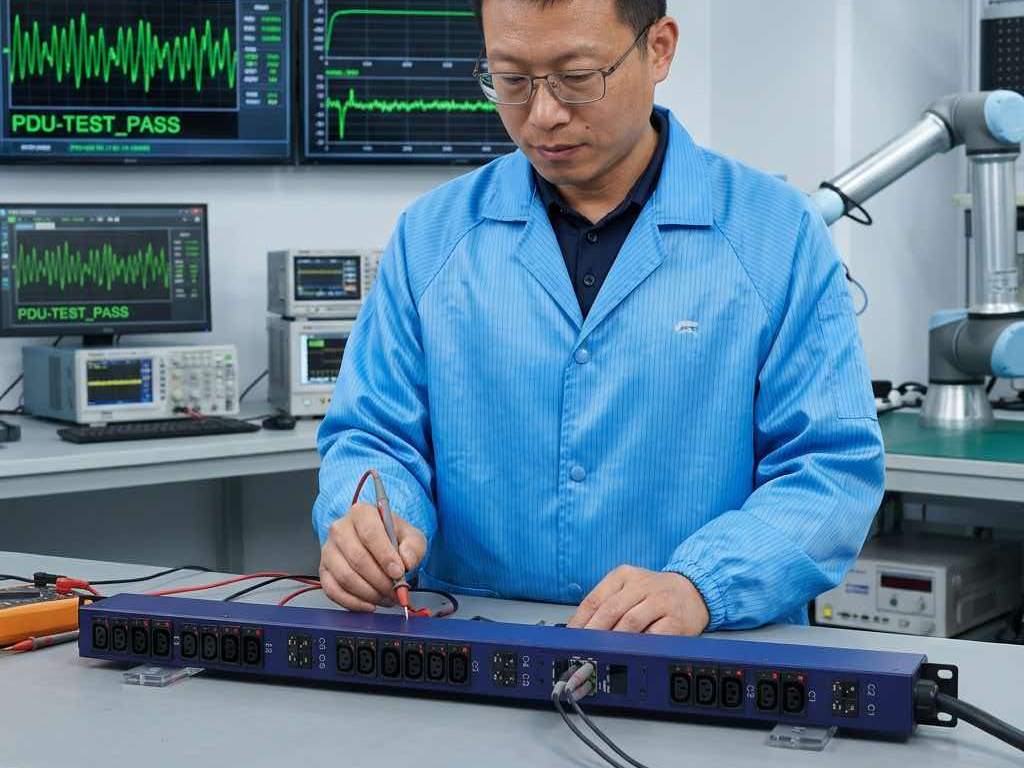
A ten-person R&D team converts a rack drawing into a buildable configuration. Our own lab runs incoming and final test on high-accuracy instruments. The copper busbar is welded in one piece without solder, which keeps joints cool under load.

Every unit goes through aging, high-current load and metering calibration before shipment. Test data travels with the shipment documents. The connector block is isolated 270° from the aluminium housing, so a loose strand cannot reach the chassis.
Products ship to the United States, Europe, Russia, the Middle East, India, South East Asia, Australia and Africa. Private-label programmes cover logo, housing colour, packaging and manuals. We also supply telecom PDU projects for domestic carrier infrastructure, where reliability requirements are strict.
We run OEM/ODM projects from rack drawing to branded product line, in four controlled layers.
Housing color for A/B feed identification, silkscreen logo, rating label, cord length 1.5–5 m
Outlet count, socket mix (C13 / C19 / C15 / universal / locking), input position, bracket type, 360° rotatable panel
Voltage class, amperage, controller tier, protocol, sensor ports, firmware and web UI branding
We confirm every option below against the model and the destination market.

You send the rack spec, drawing or competitor part number.
→ We return a clarification list.

We check phase, load, input, outlets and protection.
→ 2D drawing and configuration sheet.

We build one or two units on the confirmed configuration.
→ Sample with test data, a few weeks.
You approve the sample; we run the route for your market.
→ Certificate and DoC.

Bulk build with first-article inspection.
→ 30–45 days, with the document pack.
Send a spec sheet, a competitor part number, or a sketch.
A custom three-phase build is quoted within 24 hours, protection options included.
A single-phase PDU takes two conductors and serves racks up to 5 kW. A three-phase PDU takes three live conductors plus neutral and delivers three times the power at the same amperage. Above 10 kW per rack, the three-phase build is the lower-cost option.
North America runs 208V, either 120/208V Wye or 208V Delta. Europe, the UK, the Middle East and most of Asia run 400V or 415V Wye. The receptacle already in the rack names the system.
Yes — on a Wye system each C13 or C19 outlet delivers line-to-neutral voltage, which is 120V or 230V. Each phase carries one third of the connected load. Delta systems cannot do this, because they carry no neutral.
A 32A 400V feed gives 22.2 kVA nameplate and 17.7 kVA continuous. At 500 W per server that is 35 servers before redundancy. A 36-outlet unit caps the count at 36 single-cord devices.
No — 63A is an IEC rating and 60A is a UL/NEMA rating. Plugs, breakers and certification routes differ between them. A 63A unit will not enter a 60A receptacle.
Yes — we customize socket type and ratio (C13/C19), outlet count, phase and current rating, 0U or 1U format, input plug and locking sockets. Cord length and housing colour are fixed at order stage. On smart PDU models we also customize firmware, web UI branding, protocols and language.
Core intelligent and three-phase models are certified to UL 62368-1 and CE (LVD + EMC) with RoHS compliance. We issue the certificate number and the test report for the exact model. BIS, PSE, INMETRO and SASO/Saber are registered per order.
MOQ starts small on stock specifications. Samples take a few weeks and bulk orders run 30–45 days, set by certification and customization. We return a full quote with specifications and a certification plan within 24 hours.
A 32A breaker carries 25.6A continuously, because NEC 210.20(A) sizes protection at 125% of a continuous load and UL 489 calibrates the trip point at 40°C. A trip at 19A is therefore heat or a tired element, not overload: a thermal-magnetic breaker loses capacity once the cabinet passes 40°C. Read the three phase currents and the temperature at the breaker before adding load or ordering a replacement.
| Reading | What it means | Action |
| One phase above 25.6A | Real overload on that phase | Redistribute by power, not by device count |
| All phases below 25.6A, still tripping | Ambient above 40°C or a worn element | Measure at the breaker; fit a hydraulic-magnetic breaker |
| Trips within seconds of power-up | Short circuit or the wrong trip curve | Test the circuit before changing the breaker |
| Trips only in the afternoon | Cabinet heat rising with the room | Check rear-door temperature and airflow |
A missing phase kills one third of the outlets and pushes the redundant path to full load, which trips a split that was sized 50/50 instead of 100/100. UL 489 permits a three-pole breaker with independent trip, marked "Independent Trip" or "No Common Trip", where one pole opens and the other two keep supplying. We fit common-trip breakers on three-phase builds and report voltage per phase, so a missing leg raises an alarm before the rack drops.
| Reading | What it means | Action |
| One third of the outlets dead | Phase missing at the inlet | Read line-to-neutral voltage on all three legs, then isolate |
| Two poles closed, one open | Independent-trip breaker | Replace with common trip per NEC 240.20(B) |
| B-feed current doubles after a trip | Redundancy sized 50/50 instead of 100/100 | Size each path to carry the whole rack |
| PDU reports one phase near zero | Per-phase input metering | Alarm on phase voltage, not only on total current |
Triplen harmonics are zero-sequence, so the three phases reach the neutral in step and add instead of cancelling: neutral current equals three times the third-harmonic current. A published example with a 40A fundamental and 15A of third harmonic gives 42.7A per phase and 45A in the neutral, with the phases perfectly balanced. We hold the neutral at full phase size on every build, because a neutral reduced on fundamental imbalance has no capacity left for this current.
| Reading | What it means | Action |
| Neutral warmer than the phases | Triplen current adding in the neutral | Clamp neutral and phases at the same point |
| Phase currents equal, neutral not zero | Zero-sequence harmonics from switch-mode PSUs | Measure the spectrum, then size the neutral at 100% |
| Terminal discoloured, conductor sound | Connection resistance, not harmonics | Re-torque to the marked value |
| Neutral current above any phase | Neutral sized on fundamental imbalance only | Do not reduce the neutral on non-linear loads |
Most drift readings compare two different points: the PDU current transformer sits on the input phase, while the clamp meter sits on an outlet or the neutral. The second cause is the instrument, because an averaging meter under-reads a distorted switch-mode waveform that a true-RMS meter reports correctly. We calibrate metering to ±1% at the factory and treat a 2% gap against a true-RMS reference as the point to recalibrate.
| Reading | What it means | Action |
| PDU below the clamp meter | Averaging meter on a distorted waveform | Re-measure with a true-RMS instrument |
| Gap on one outlet only | CT on a different conductor | Measure phase and neutral at the same point |
| Gap grows over months | CT ageing or thermal drift | Recalibrate against a reference |
| Reading unstable at low load | CT at the bottom of its range | Compare at 30% load or above |
Tripped, hot, or drifting? Send the readings.
Send the three phase currents, the breaker curve and a photo of the input. We tell you whether the load or the hardware is at fault, within 24 hours.
A Professional And Leading Manufacturer
For OEM
& ODM Power Distribution Unit (PDU)
You Can Trust
CONTACT
Ningbo YOSUN Electric Technology Co., LTD
Leading Professional Manufacturer in PDU Power Solutions
Contact Info.
Leave Your Message