


© Copyright – 2010-2023 : All Rights Reserved. Sitemap
Power Distribution Unit PDU, rack mount PDU, PDU data center, Smart PDu, intelligent PDU
Power Distribution Unit PDU, rack mount PDU, PDU data center, Smart PDu, intelligent PDU


+86 15867381241
Server Rack PDU
We build server rack PDU to the cabinet drawing: 0U vertical, 1U and 2U horizontal, 10A to 160A, single and three phase, 4 to 24 outlets on a standard panel. Send one rack spec and we return the feed, the outlet layout and the monitoring tier that fit it, with the certificate scope for your market. Metering, switching, inlet type and outlet mix are configured on the same chassis, so a cabinet that matches no standard model is still built without a new platform.
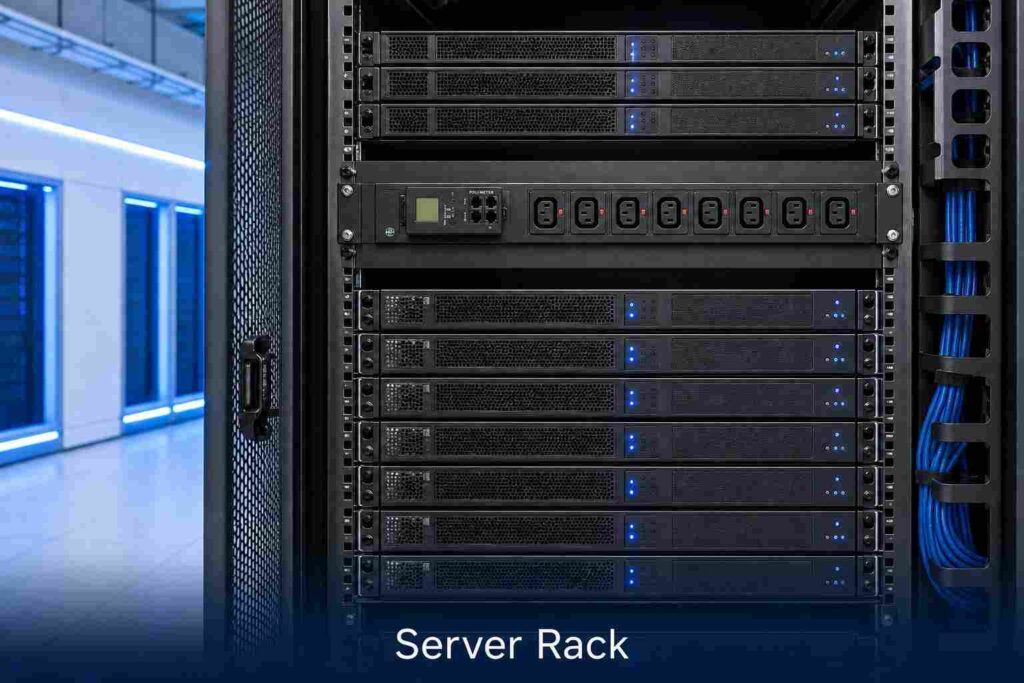
A rack is bought with an outlet count and installed against an inlet rating, and the two have to be fixed together. We start from your load list, derive the feed from it and let the outlet count follow, so the strip arrives with both already matched.
Your feed leaves the UPS, passes a branch breaker, enters the cabinet and reaches the server through a server rack PDU and one cord. The PDU is the only one of those four parts inside the cabinet, so we treat the outlet count, the outlet standard and the reading your operator can reach as one specification rather than three. We read the inlet rating before the outlet count, because a 16A inlet caps the strip at 16A whatever the panel is cut for.
A server room cabinet holds servers and storage on four posts and takes C13 and C19 cords, and a network cabinet holds switches on two posts, where the space behind the rear door decides what fits. We build for both, from a 1 kW switch cabinet to a 30 kW server rack, and we quote the mounting format against your drawing rather than against a preference. A room with ten rows of these cabinets is covered on our data center PDU page.
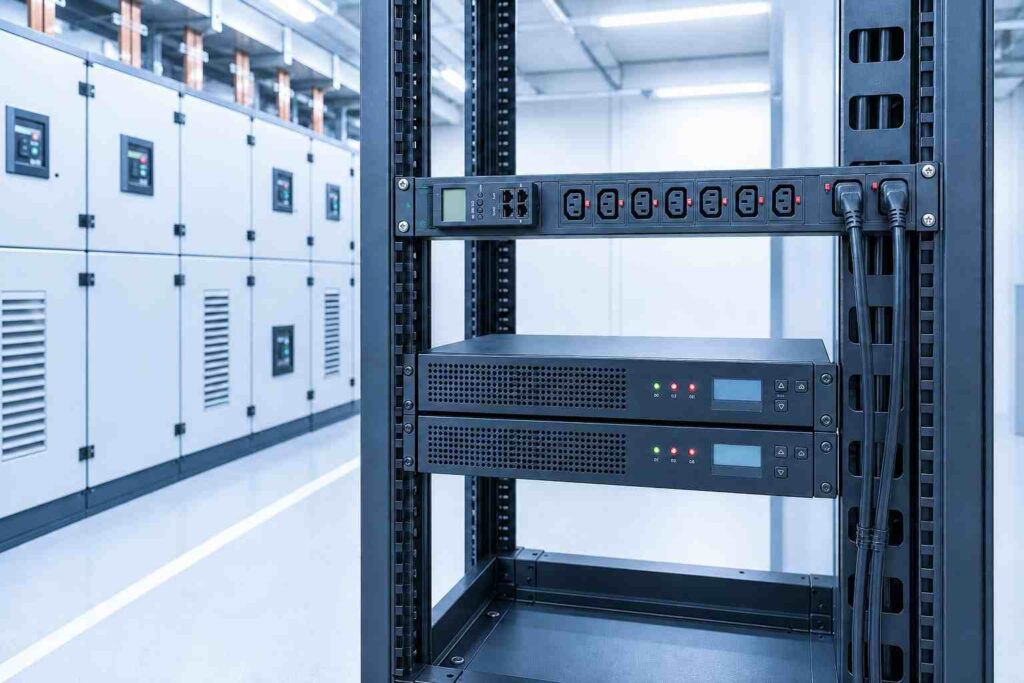
Send the rack drawing and the load list.
We return the phase, the current band and the outlet layout that fit the cabinet, with the reason for each.
The rack specification errors we are asked to correct most are an inlet that is too small under an outlet panel that is too big.
We fix the feed first and let the outlet count follow.
| Feed | Rated capacity | Continuous at 80% | Where it fits |
| Single phase 120V 15A | 1.80 kVA | 1.44 kVA | A network cabinet on a 15A branch |
| Single phase 120V 20A | 2.40 kVA | 1.92 kVA | A switch cabinet on a 20A branch |
| Single phase 230V 16A | 3.68 kVA | 2.94 kVA | A small server cabinet, one feed |
| Single phase 208V 30A | 6.24 kVA | 4.99 kVA | A twist-lock cabinet on a 30A branch |
| Three phase 208V 30A | 10.81 kVA | 8.65 kVA | A 42U server cabinet at 8 kW |
| Three phase 208V 60A | 21.62 kVA | 17.30 kVA | Two cabinets on one feed |
| Three phase 400V 32A | 22.17 kVA | 17.74 kVA | A dense server rack at 17 kW |
| Three phase 415V 63A | 45.28 kVA | 36.22 kVA | A row of dense racks on one feed |
Capacity from V × A × 1.732 ÷ 1000 on three phase and V × A ÷ 1000 on single phase; the continuous column applies NEC 210.20(A). Calculated by us for this page.
Capacity is V × A × 1.732 ÷ 1000 on three phase and V × A ÷ 1000 on single phase. NEC 210.20(A) limits a continuous load to 80% of the branch rating, so a 30A 208V three-phase feed carries 8.65 kVA and not 10.81 kVA, which is the figure we size your rack against. We compare your rack nameplate with the continuous column, not the rated one, before we propose an inlet.
A single phase feed reaches 3.68 kVA at 230V 16A, which covers a switch cabinet and a small server cabinet. Three phase reaches 10.81 kVA at 208V 30A and 22.17 kVA at 400V 32A, and it spreads the load across conductors so a dense rack does not sit on one of them. We build the three phase PDU line in 16A, 32A and 63A with mixed C13 and C19 outlets, and the single phase PDU line from 10A to 32A.
AI and HPC racks at 50 kW to 300 kW leave 30A and 60A feeds behind and land on 63A three phase or a hardwired junction box. We build a 1U junction box to 63A at 400 VAC three phase, and the 100A/125A junction box covers the feed side of a 100A rack. Send the rack load in kW with the destination market and we return the feed with the outlet split.
Give us the rack load in kW.
We return the feed, the current band and the outlet count with the 80% rule already applied.
An outlet standard fixes the cord, the current and the market, so we cut the panel to your device list and specify the inlet in the same step.
What you send is a cord count, and what we return is a panel drawing.
IEC 60320 C13 carries 10A at 250 VAC and C19 carries 16A at 250 VAC. A C19 outlet takes the cord of a blade server or a switch power supply, so we build a mixed panel for a rack that carries both device types. We cut the C13 to C19 ratio per project instead of shipping one fixed pattern of eight.
NEMA 5-15R takes 15A at 125V and 5-20R takes 20A at 125V, and both pair with a 5-15P or 5-20P inlet. We build the 250V twist-lock family in L6-20R and L6-30R, and an L14-30P inlet brings two 120V legs into one 30A strip. The NEMA PDU range covers the whole family, including the L5-20P and L5-30P inlets.
Schuko, BS 1363 and French 16A outlets all sit on a 230V 16A inlet, so the outlet you choose decides the destination market before the certificate does. We build the UK version at 13A 250V through a fused plug, and a 16-outlet 2U panel in two colours so the A and B feeds of a dual-feed rack can be told apart at the door. The Schuko PDU and UK PDU lines both carry that option.
A locking C13 holds the cord against vibration and against a cable pulled during maintenance. We fit a copper alloy contact rated for 5,000 plug cycles in a PC/ABS body rated UL94-V0 with a thermal deformation point above 120°C. Locking outlets go on as standard where the strip feeds switches and storage, because a loose cord there interrupts service.
Send the device list with cord types.
We return the C13 to C19 ratio, the panel layout and the inlet that feeds it.
The mounting format follows the cabinet and the free space in it: a 0U strip takes no rack units, a 1U strip fits a shallow cabinet, and a 2U strip carries the larger outlet count. We build all three on the same drawing process, so the format stays a decision on your cabinet and not on our range.


A 0U strip mounts vertically on the rear posts or the side frame, uses no rack units, and we build its panel to rotate 360 degrees. A 1U unit takes one rack unit and carries 4 to 16 outlets on our standard panel, which suits a network cabinet with limited rear depth. A 2U unit doubles the panel area to 12 to 24 outlets, where C13 and C19 share a strip, and all three mount without tools.
| Format | Rack units | Outlets on a standard panel | Where it fits |
| 0U vertical | 0 | 12 to 24, more on full-height panels | Server cabinets and dense racks with rear post clearance |
| 1U horizontal | 1 | 4 to 16 | Network cabinets and shallow racks |
| 2U horizontal | 2 | 12 to 24 | Server cabinets with mixed C13 and C19 |
We specify 0U for a cabinet already full of equipment, for a rack where each device should reach power near its own rear port, and for a dual-feed rack with one strip on each rear post, which keeps the A and B feeds apart for the full height of the cabinet. We steer you to a 1U or 2U horizontal unit when the cabinet is shallow, when the strip has to be reachable from the front, or when only one or two rack units are free. Our vertical PDU page carries the 0U and full-height formats.

| Cabinet type | Posts | Mounting that works | What decides the format |
| Open frame | 2 or 4 | 0U on the post, 1U on the front rail | Post thickness and clearance |
| Enclosed server cabinet | 4 | 0U on the rear post, 1U or 2U front or rear rail | Free rack units and rear depth |
| Network cabinet | 2 | 1U on the front rail, 0U on the post | Depth and switch port side |
| Wall cabinet | 2 | 1U front rail, 0U on the side frame | Cabinet height |
Send the cabinet drawing with post type and depth.
We return the format and the outlet count that fit the free space, and say which of the three we would build.
Each tier answers a different question, from a local reading to remote outlet control, and all four sit on one chassis platform.
We ask who reads the meter and how often, then build the tier that answers it, so a rack can move up later without changing its mounting.
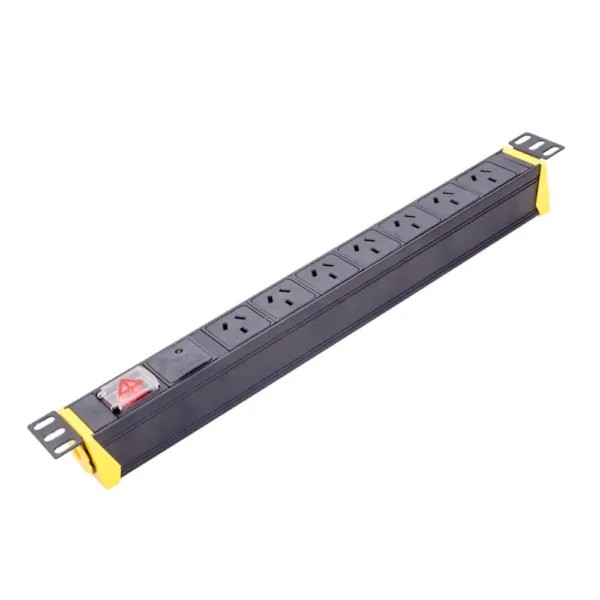
A basic unit distributes power and carries no meter, with protection left to the upstream breaker. We build it for a rack with a fixed device list and a load that is known at design time, where a meter would be read once a year. It is available in 1U, 1.5U and 2U form.
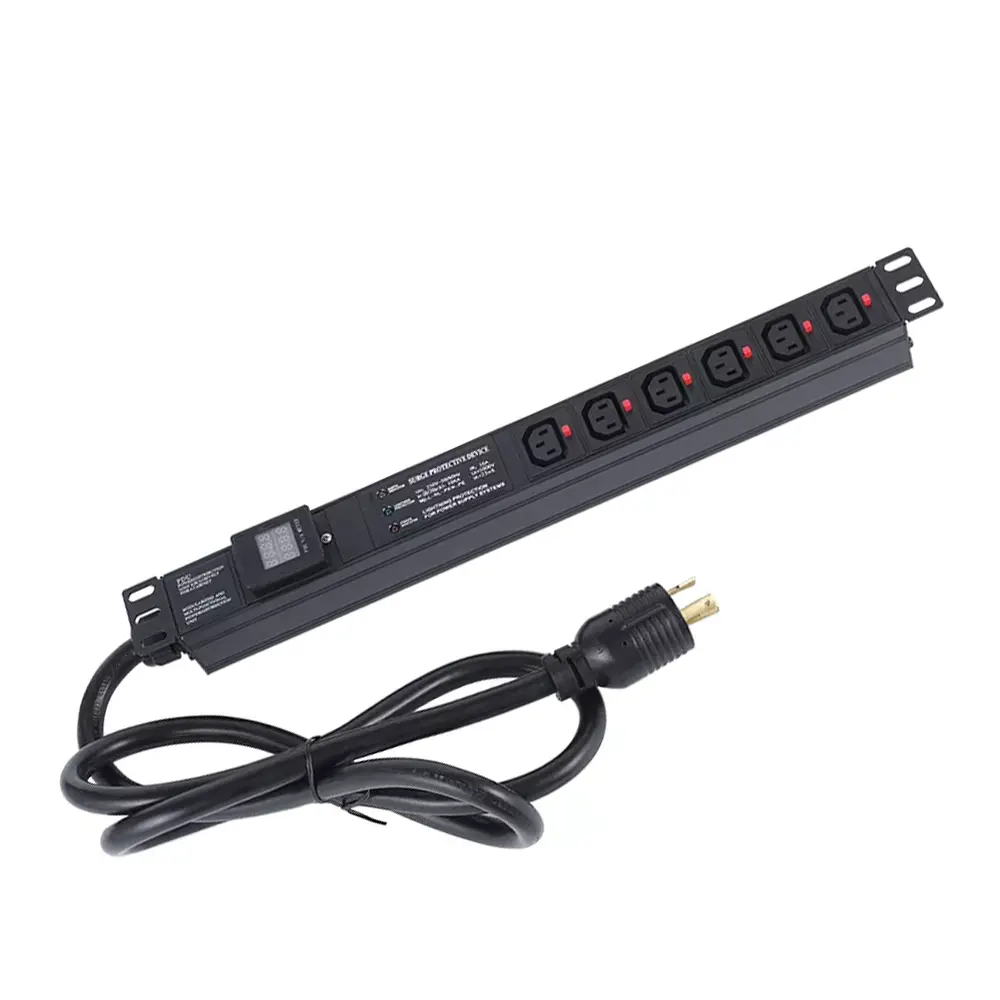
A local meter shows inlet voltage and current on an LED or an LCD, with no network card and no IP address. We build it for a single cabinet where someone opens the door and reads the number, and we fit an LED ammeter, an LCD or an OLED touch display to that brief.
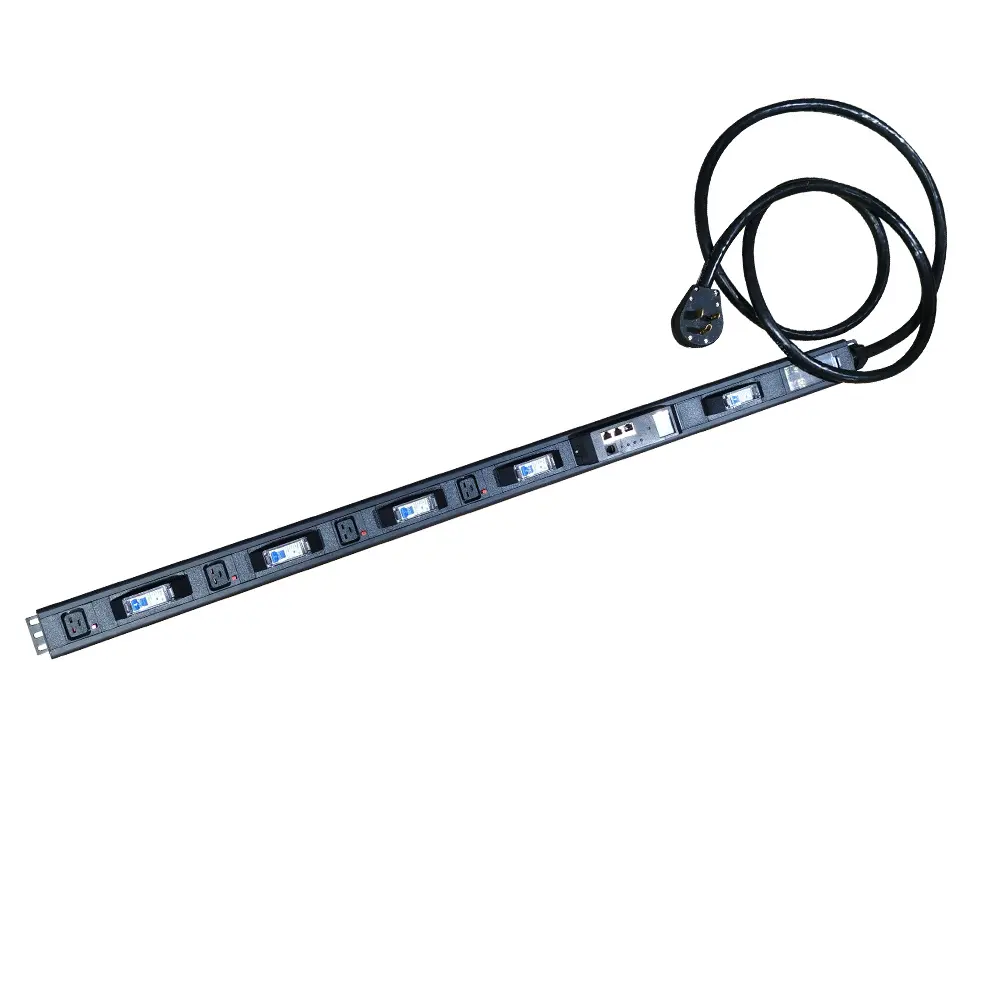
A monitored unit puts inlet voltage, current, energy and power factor on SNMP, Modbus or HTTP, and raises an alarm when a threshold is crossed. Our 485 monitor cascades up to 64 units on single phase and up to 247 on three phase, so a room of cabinets reports to one console.
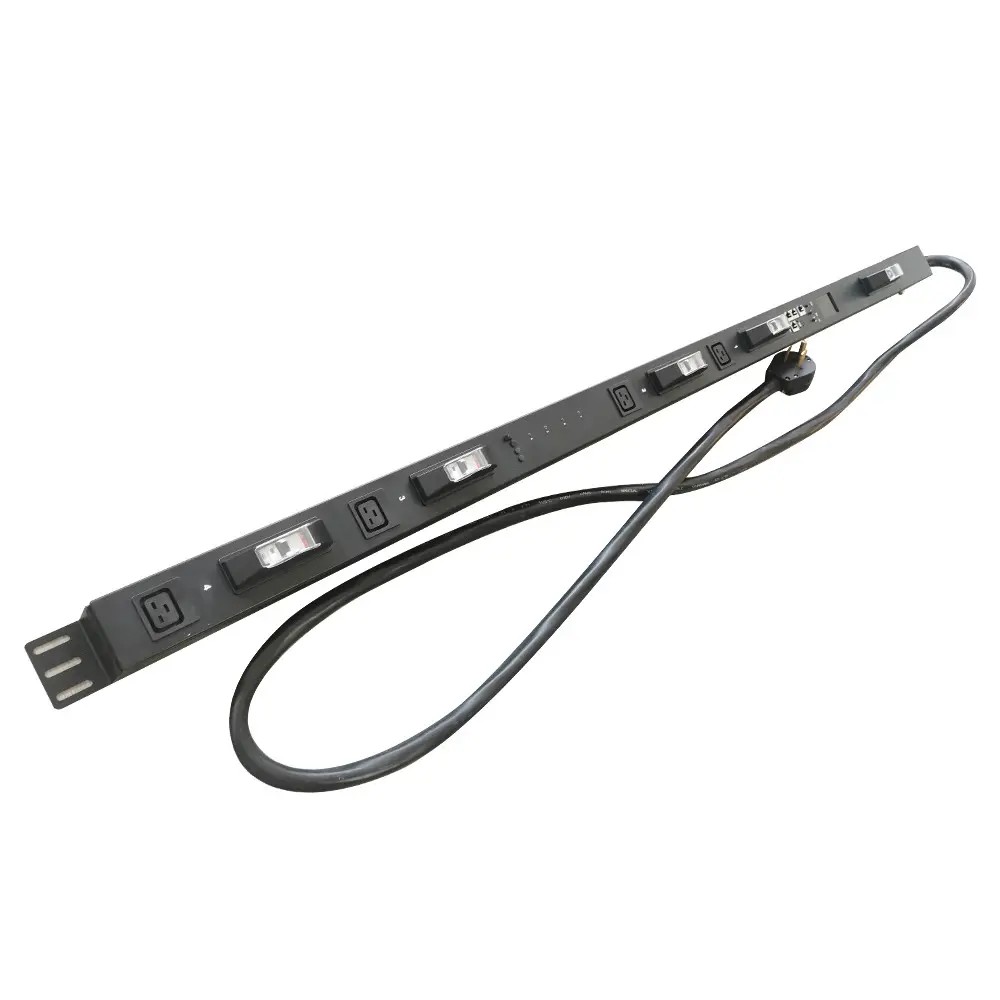
A switched unit opens and closes individual outlets from a browser, and the same outlet reports its own current where per-outlet metering is fitted. We configure power sequencing delays so equipment comes up in a set order and the inrush of a full rack does not trip the branch breaker.
| Tier | What it reads | What it controls | Cabinet it suits |
| Basic | nothing | nothing | Fixed load, known device list |
| Metered input (PIPS) | inlet voltage and current | nothing | One feed, one reading, no network |
| Metered by outlet (MBO) | current per outlet | nothing | Mixed load, one tenant per outlet |
| Monitored | inlet plus sensors, over the network | nothing | A room of cabinets on one console |
| Switched | inlet or per outlet | each outlet on and off | Remote sites and unmanned rooms |
| Bypass and ATS | inlet, with feed status | feed selection | Maintenance windows and dual feeds |
Our network card speaks SNMP v1/v2c/v3, Modbus RTU over RS-485, HTTP and HTTPS, SSH v2, MQTT and a REST API, and up to 32 units cascade behind one IP address. We state metering accuracy as ±1%, the class billed to a tenant and used for capacity planning. We confirm the protocol list on the exact model and firmware revision before quotation, because a chassis that supports a protocol in one revision does not support it in every revision.
Tell us who reads the meter, and how often.
We return the tier that covers it, from a local meter to remote outlet control.
A single feed makes the strip a single point of failure, and the three devices that answer it answer three different failures. We ask for your two feed sources and your maintenance plan, then build the one that covers the failure you have.
An ATS PDU takes feed A and feed B and holds the load on one of them, so a lost feed does not take the rack down. The transfer is break-before-make, which is why we specify an ATS for a feed failure and not for a load that cannot see a gap. We build it on 120V, 208V and 230V inlets from 16A to 32A, with SNMP on the 16A model.

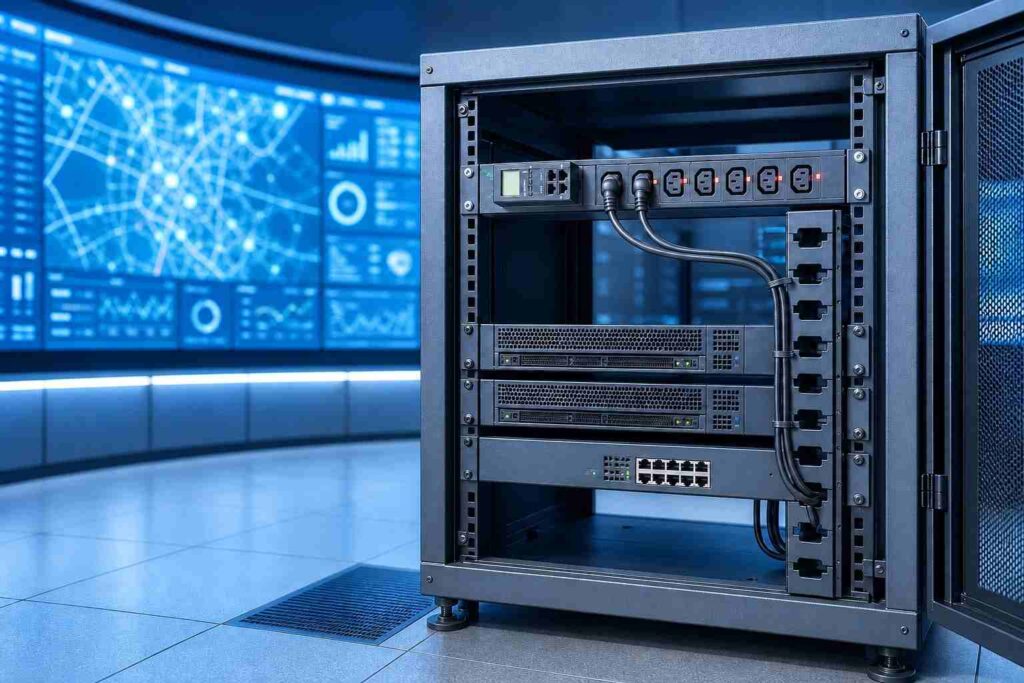
An STS PDU moves the load with semiconductors, so the transfer completes inside one cycle instead of the gap a mechanical transfer leaves. That is the difference we specify for a switch stack that reboots on an interruption it can see. We build STS on 208V and 230V inlets up to 32A.
A hot swap PDU with bypass moves the load from UPS power to utility power, so battery replacement or a new UPS install runs while the rack stays on. We build the manual version for a transfer at the cabinet, in the hands of your engineer, with no network dependency. It is built from 10A to 32A in horizontal and vertical form.
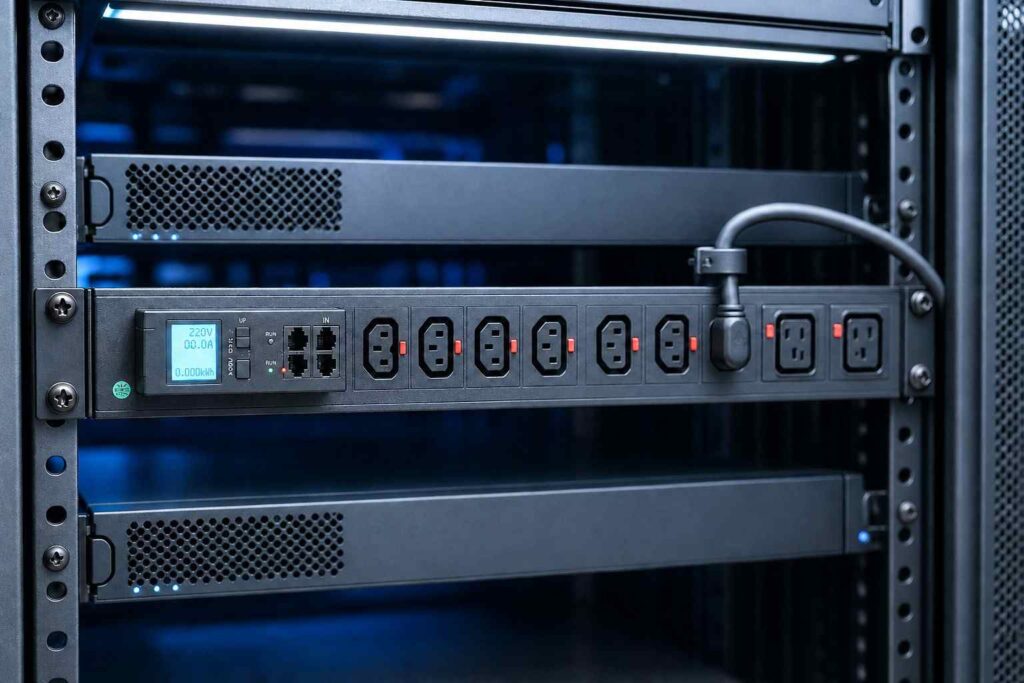
A feed failure needs an ATS or an STS, a maintenance window needs a bypass, and a rack with two cords from two strips needs none of the three. We say so when that is the case, because dual-corded servers already carry their redundancy upstream and the second feed and the second strip deliver more than a transfer device. Send the two feed sources and the maintenance plan and the transfer type selects itself.
Send your two feed sources and the maintenance window.
We return the ATS, STS or bypass layout that covers the failure you actually have, or tell you that none is needed.
Send the cabinet drawing and the load list.
We return the two configurations that fit the cabinet: one standard, one adapted.
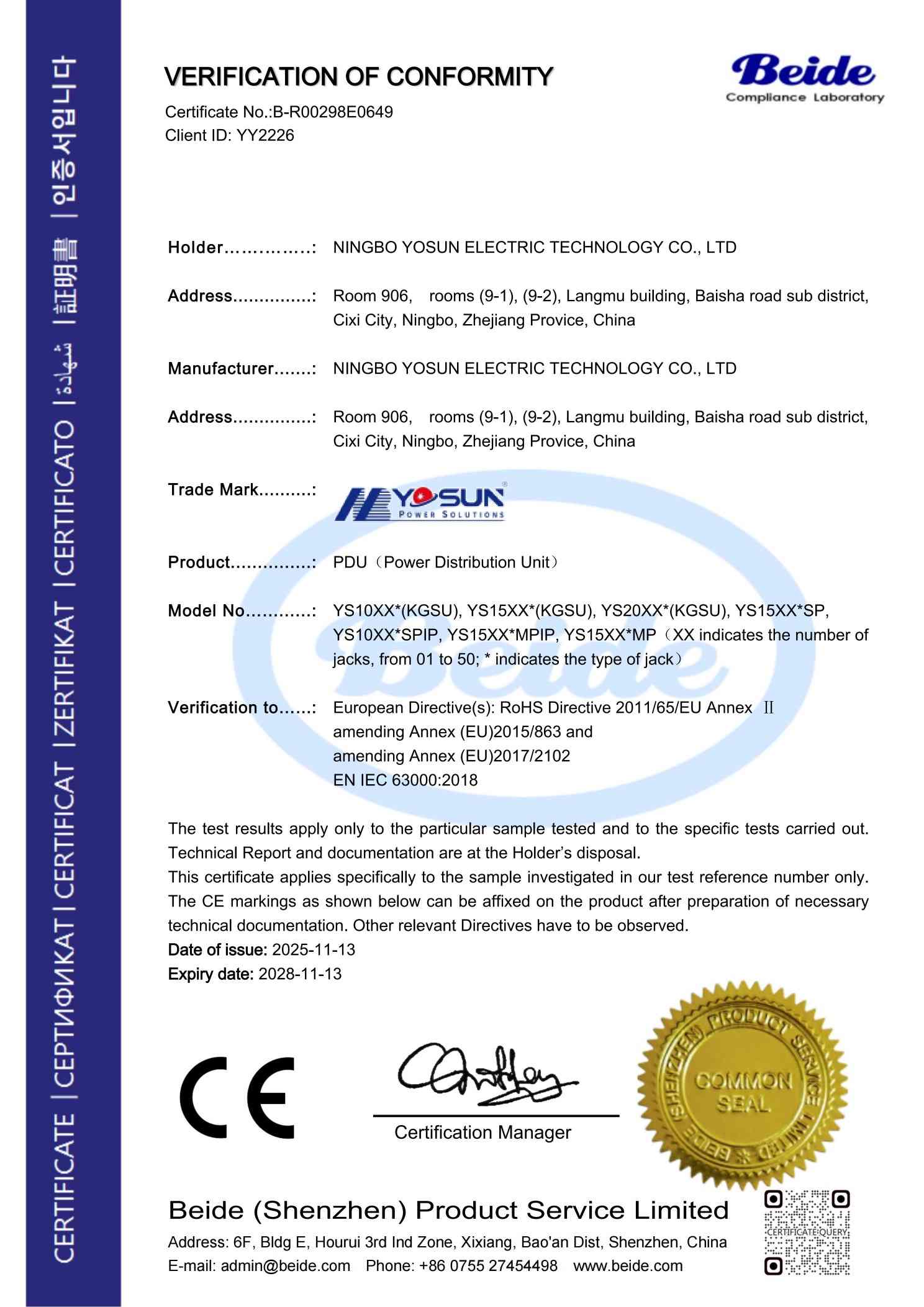
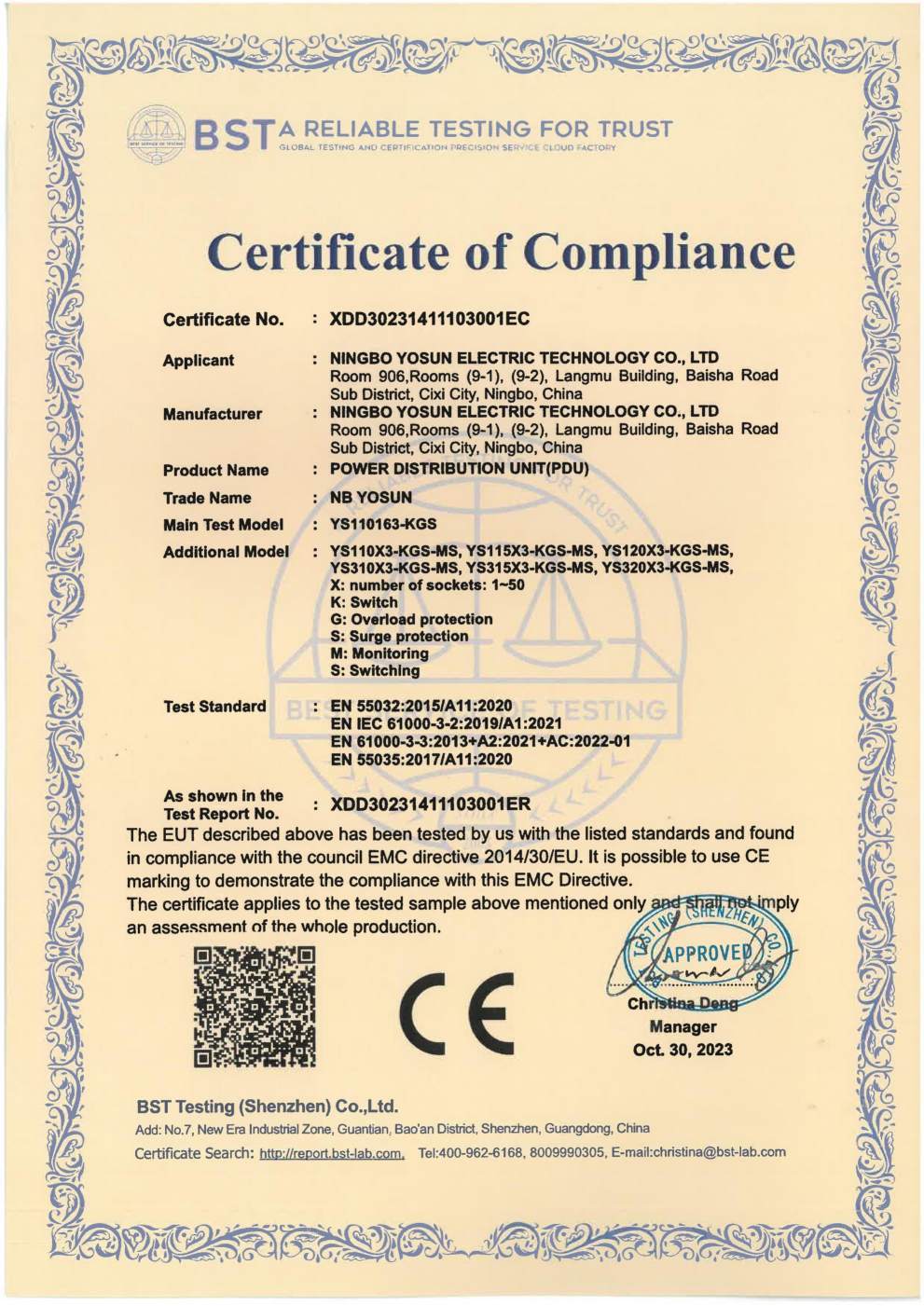
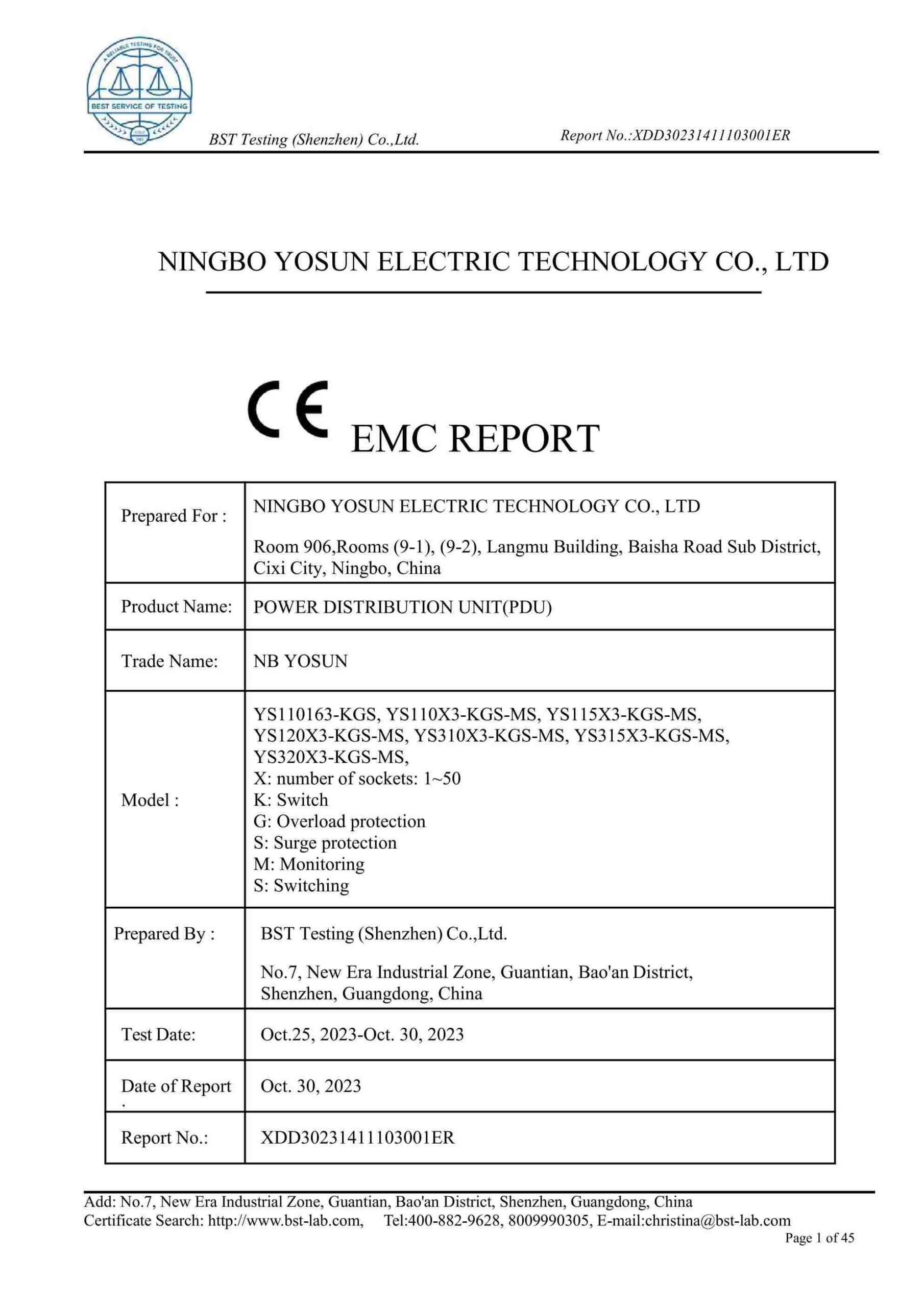
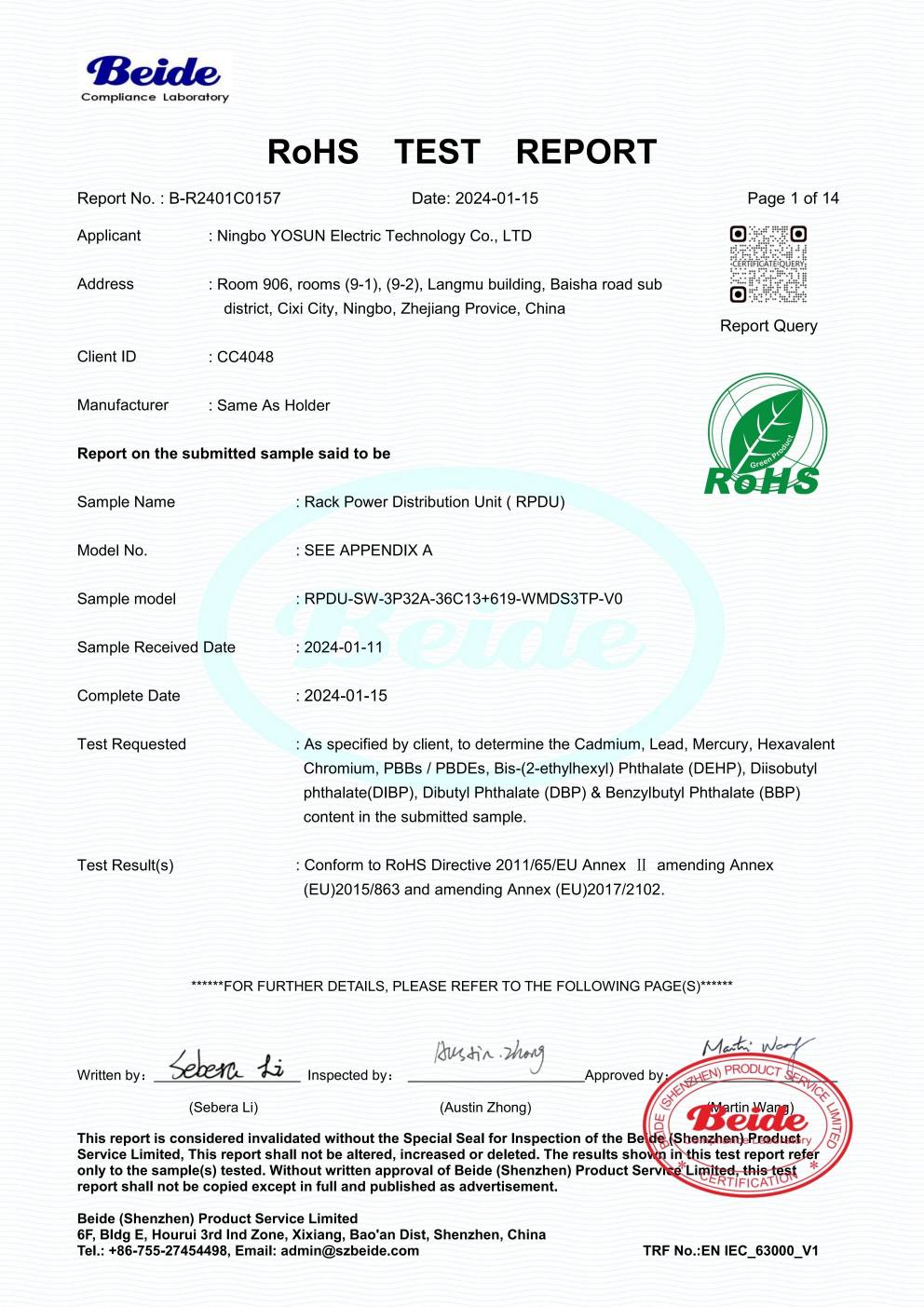
Core intelligent and three phase models are certified to UL 62368-1 and to CE under LVD and EMC, with RoHS material compliance. We send certificate numbers and test reports with the quotation for the model quoted, not with the catalogue. For India, Japan, Brazil and Saudi Arabia we support BIS, PSE, INMETRO and SASO/Saber on order.
| Market | Document | Model scope |
| United States and Canada | UL 62368-1 file, cUL where applicable | Core intelligent and three-phase models |
| European Union | CE declaration, LVD and EMC, RoHS | Same model scope as UL |
| United Kingdom | UKCA | UK plug models |
| China | CCC | C20 inlet model |
| Australia | SAA / RCM | AU plug model |
| India, Japan, Brazil, Saudi Arabia | BIS, PSE, INMETRO, SASO/Saber | Confirmed on order |
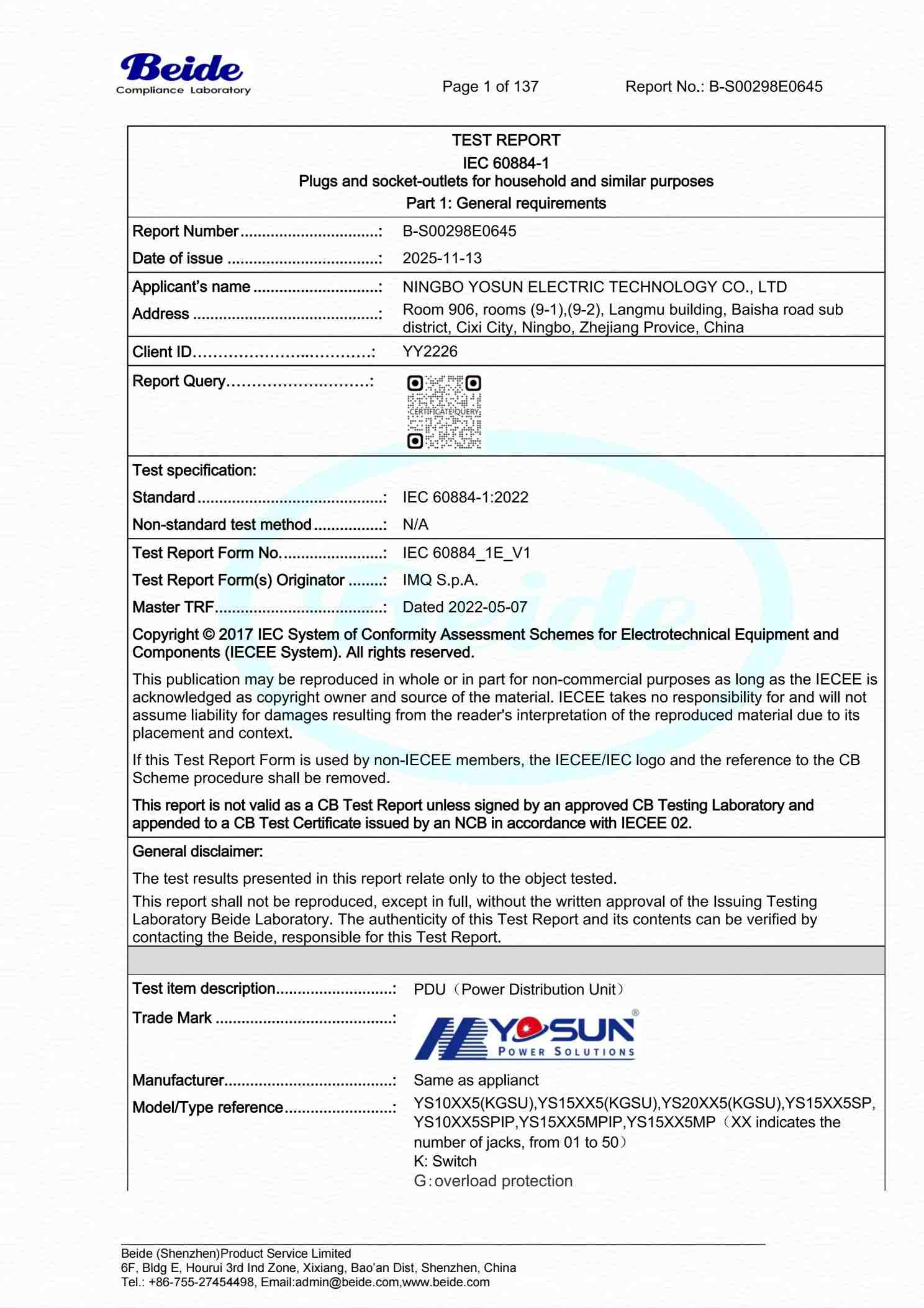
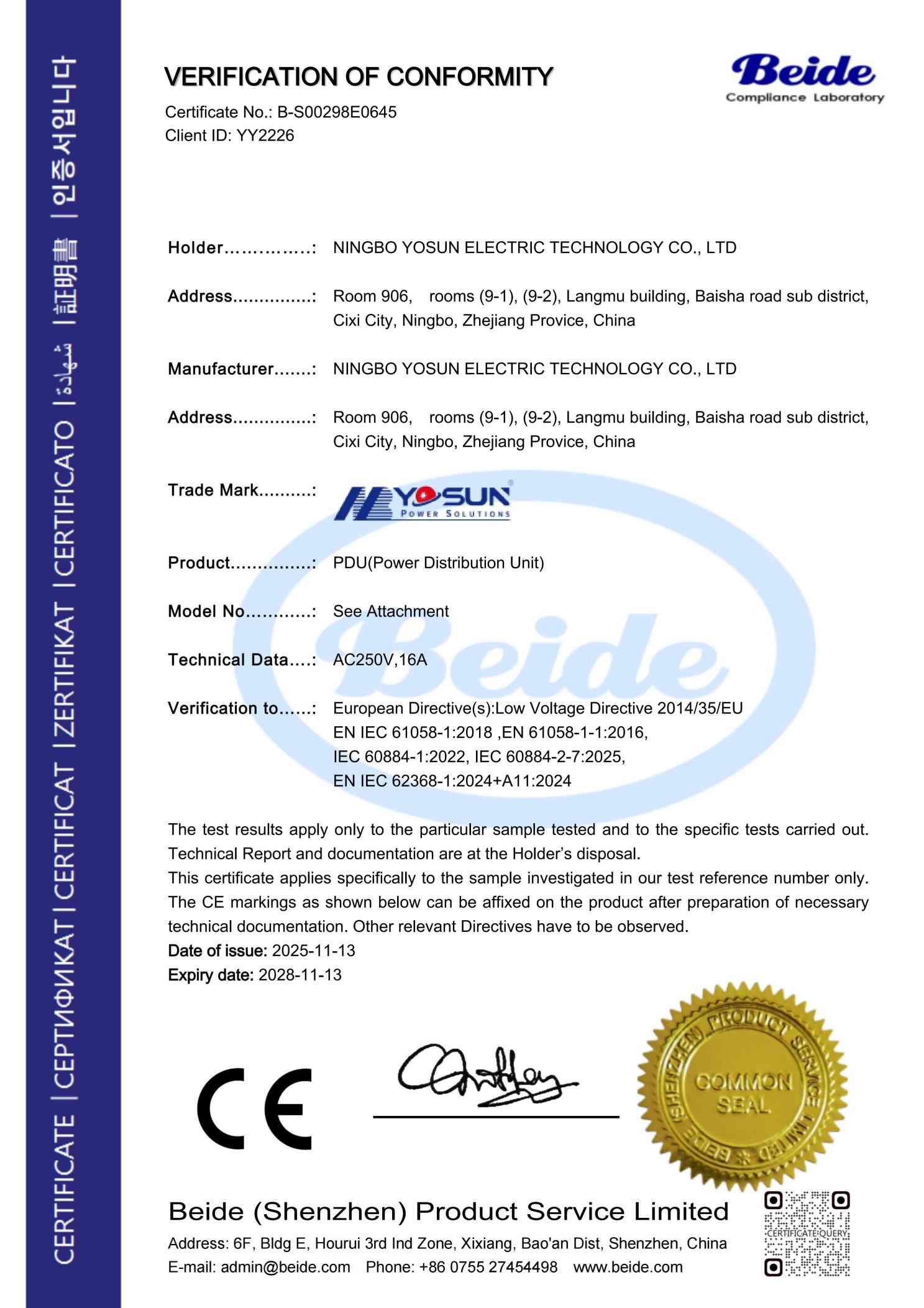
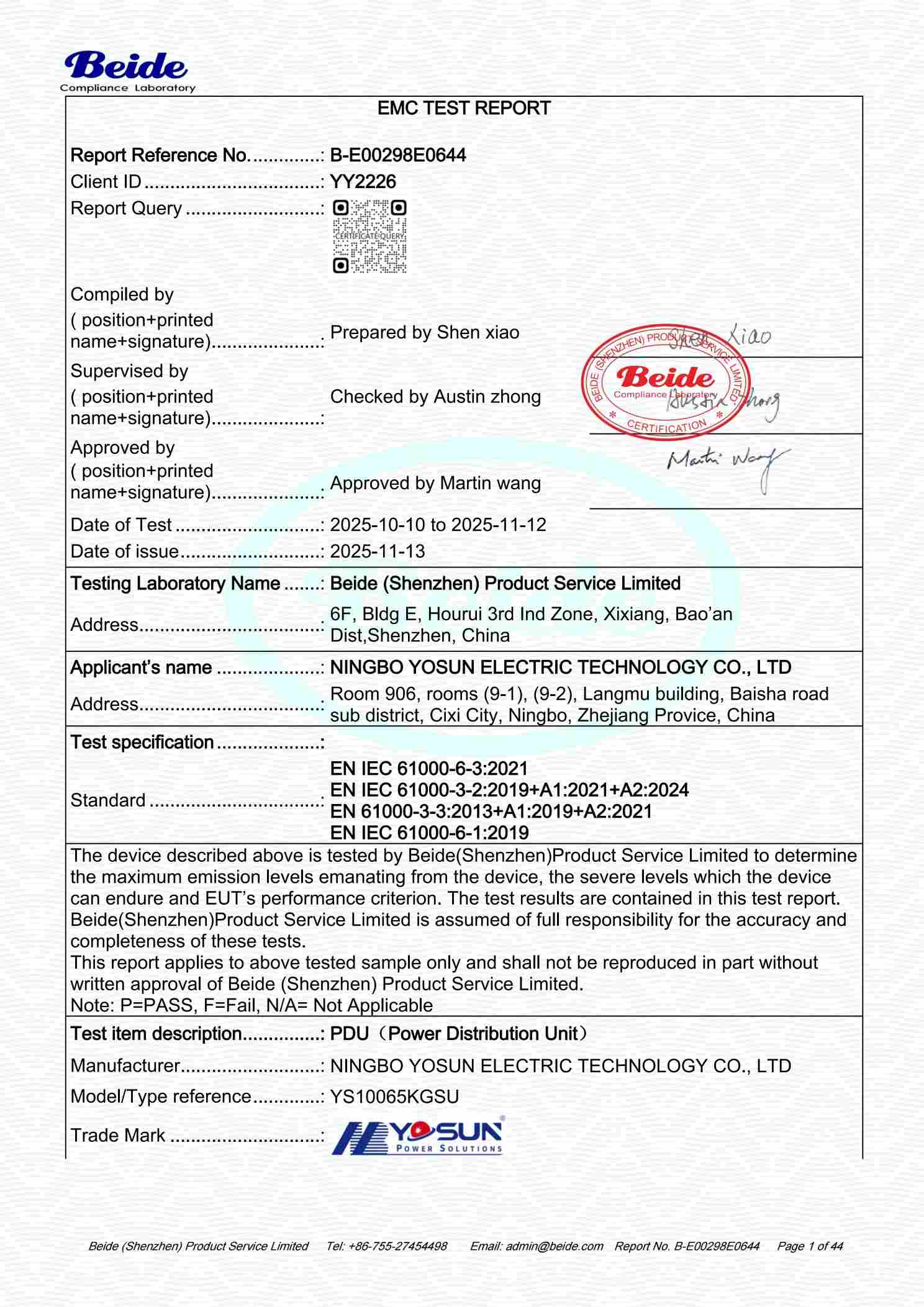
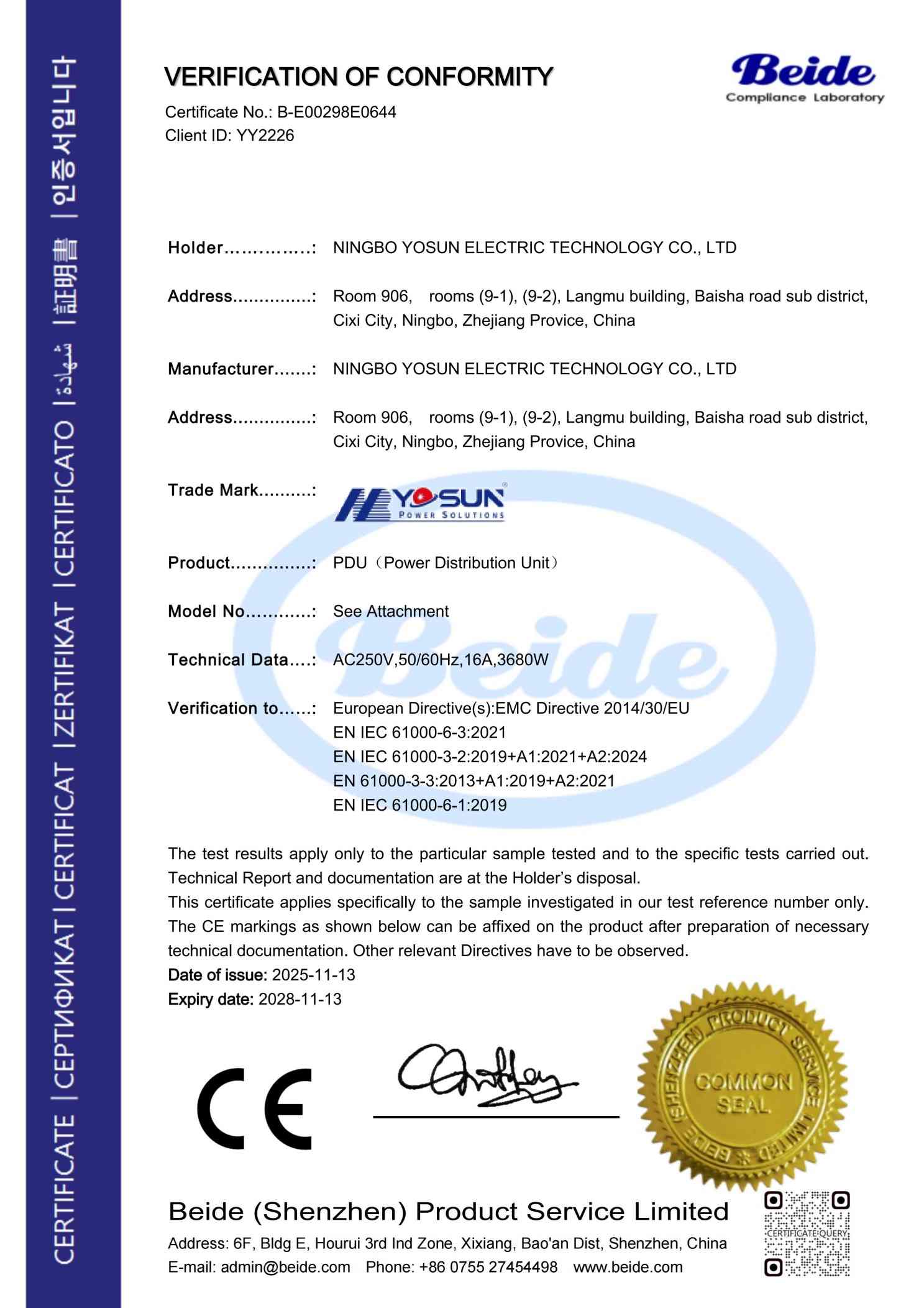
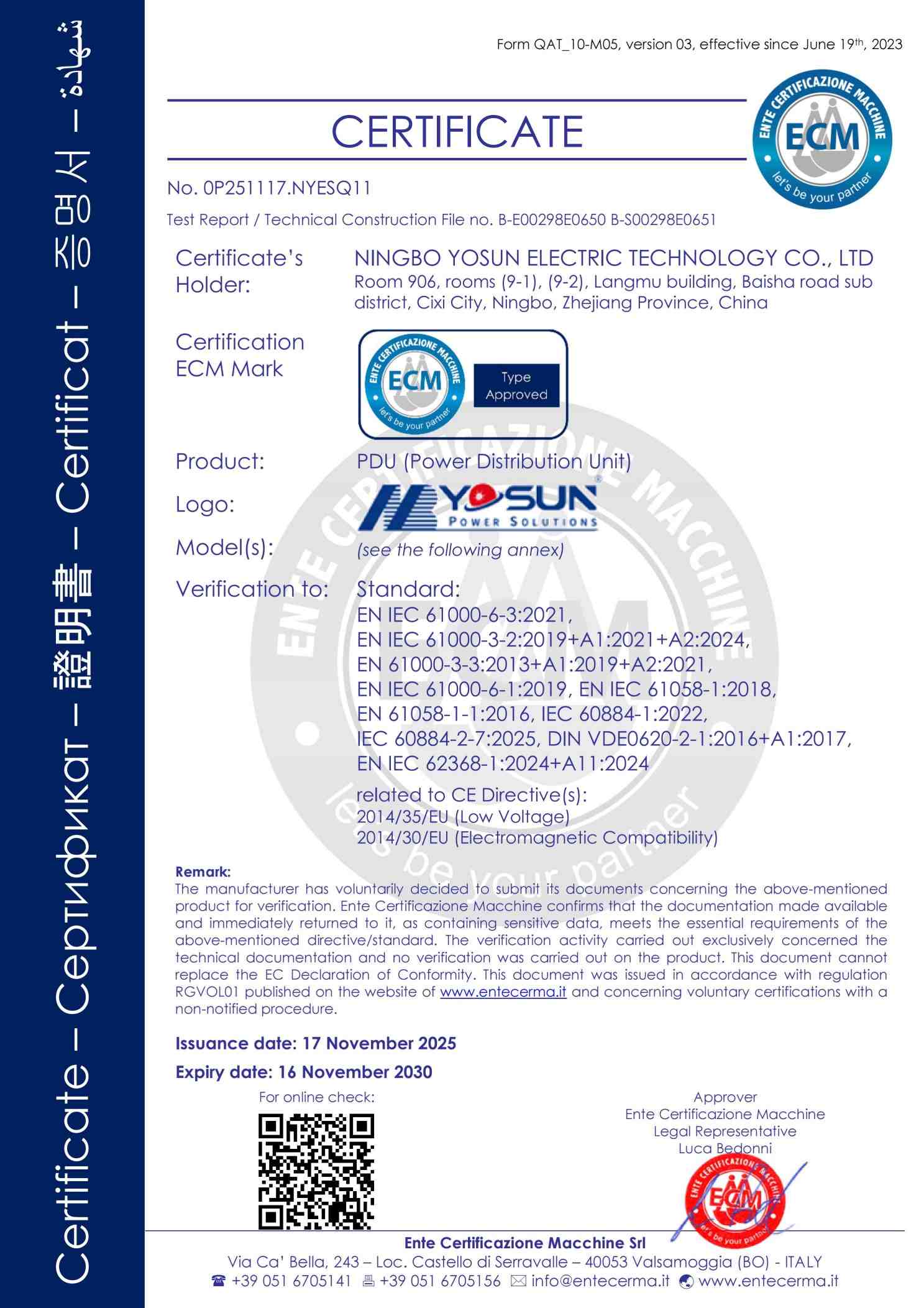
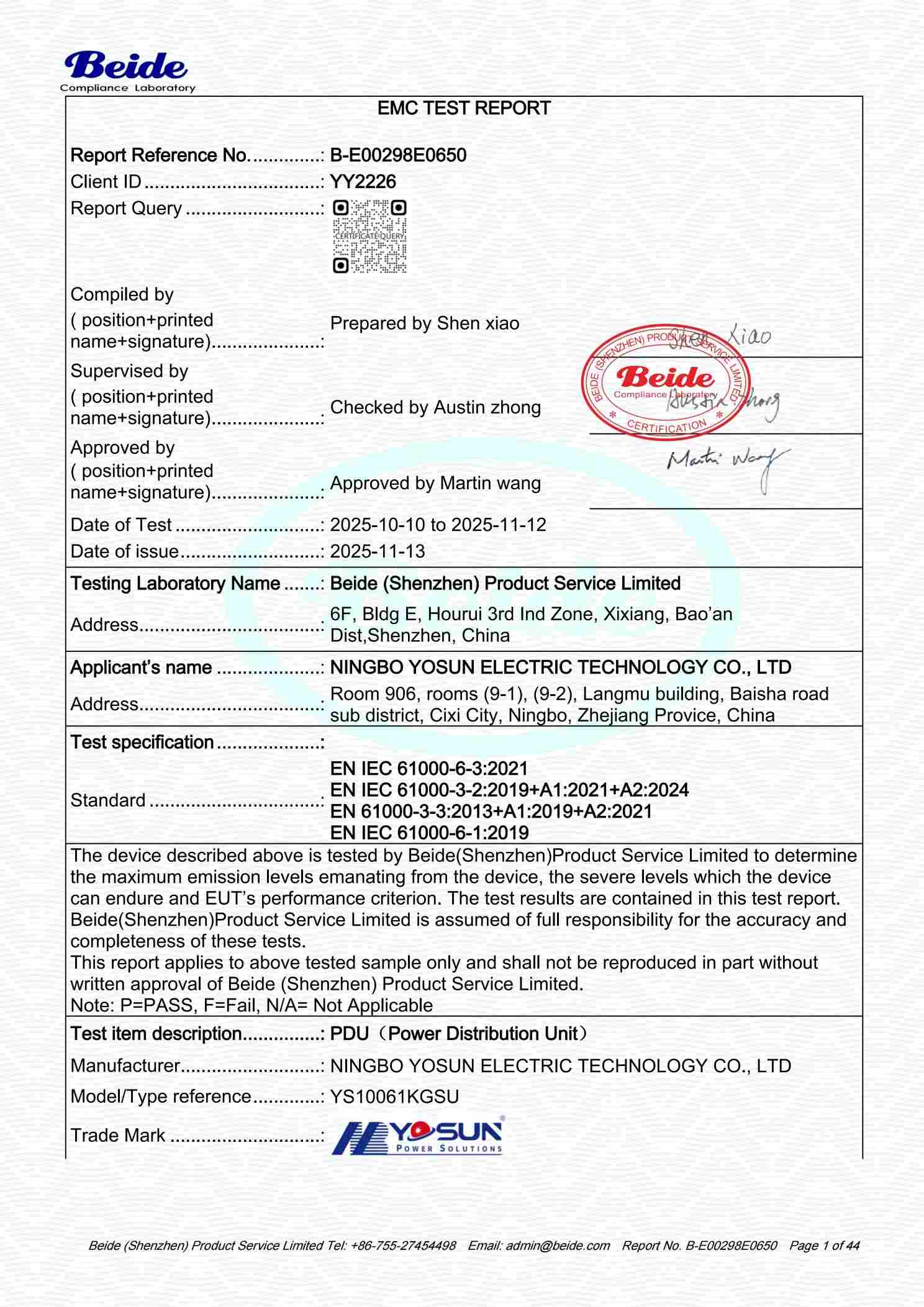
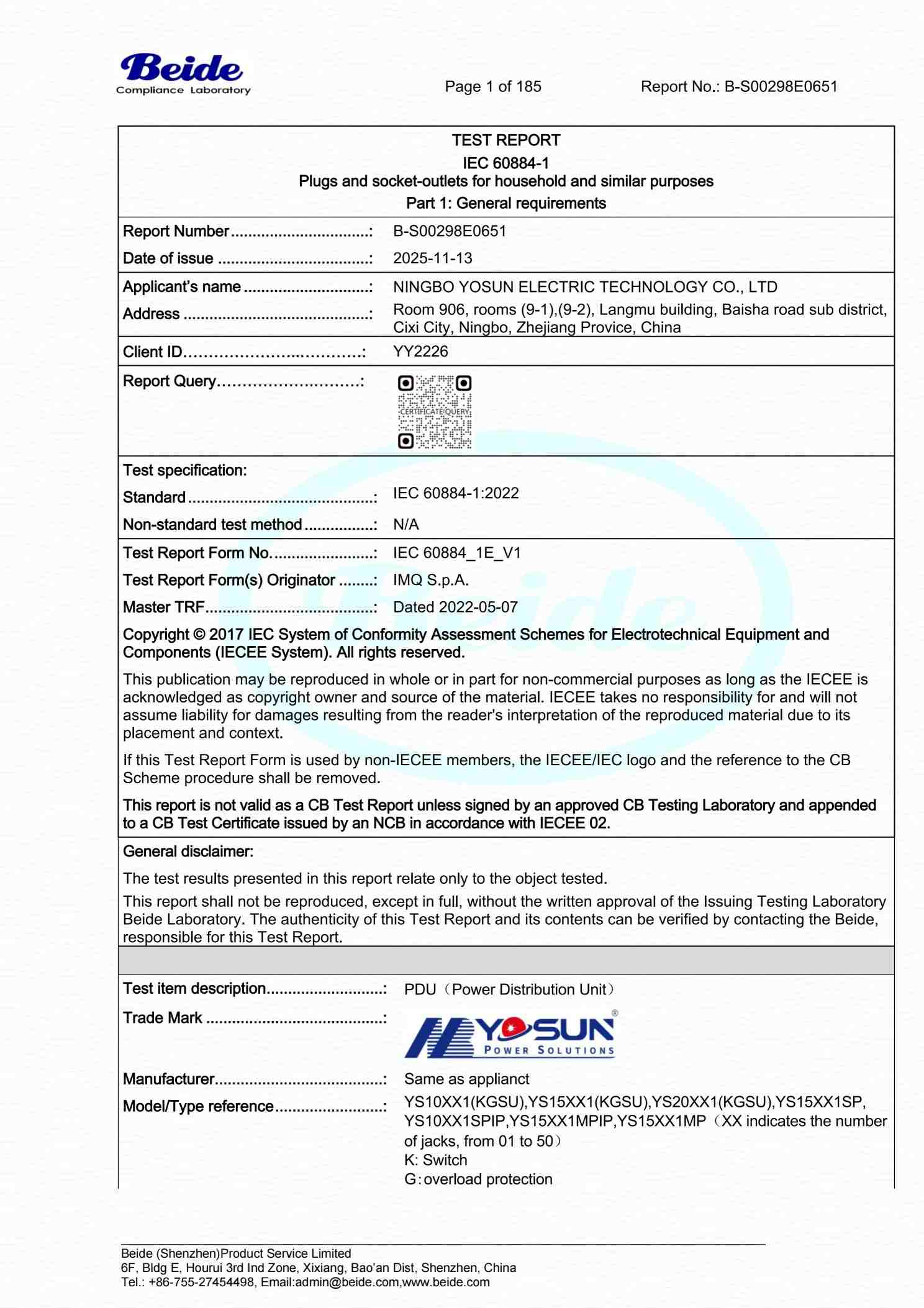
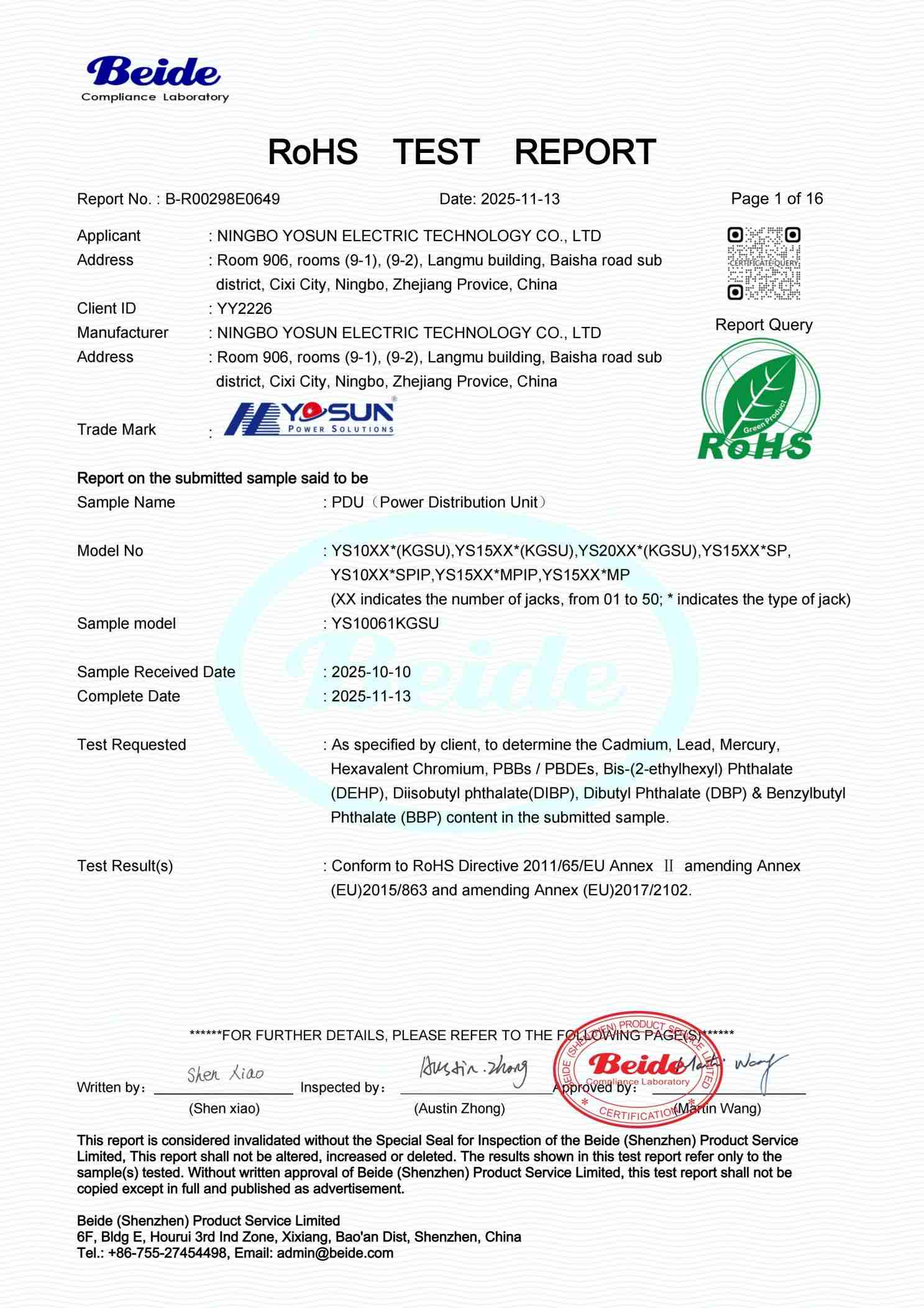

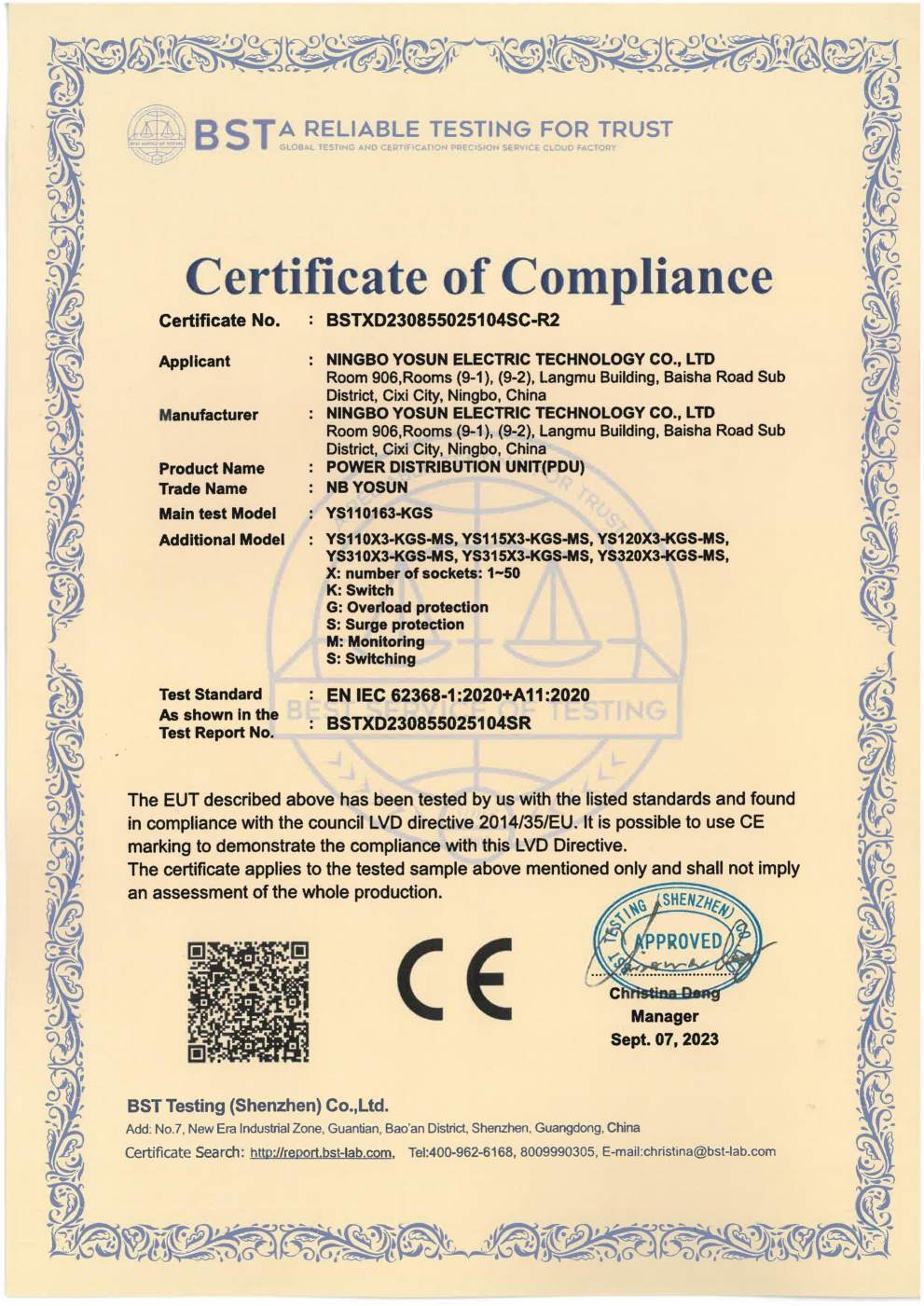
Name the destination market and the model.
We return the certificate number, the issuer and the standard it applies, or say that the model needs a new test.
We run production, moulding and testing in our own plant, which is why a drawing change is a schedule change and not a negotiation with a subcontractor.
We weld the busbar from one piece of copper without solder, and it carries 10A, 16A, 32A, 63A, 80A or 125A depending on the model. A solder joint adds resistance and a heat source, and a welded joint does not, which is the reason we build it this way. The U-profile PVC board holds a 270° isolation between the live parts and the housing.
Our injection moulding workshop sits in the same plant, so a housing colour or a socket cut is a mould change rather than an outsourced order. We extrude and cut the aluminium housing on site, and we build a plastic housing on the same chassis where a project needs one. A 10-engineer R&D team turns your drawing into a sample before the tooling is fixed.

Every unit runs an aging test, a high-current load test and a metering calibration before we pack it. We warrant the unit for 24 to 36 months and answer the technical line within 24 hours. A bulk order ships in 30 to 45 days, and a sample ships in weeks.
We send a candidate model with a datasheet, the applicable compliance file, the test record and the interface drawing. We confirm certification, accuracy, protocol and MOQ per model, not per catalogue page. Ask for the pack on the model you are comparing, because it is the same pack your customer will ask you for.
We run OEM/ODM projects from rack drawing to branded product line, in four controlled layers.
Housing colour, logo, packaging, label language
Length, width, mounting bracket, display orientation
Phase, voltage, current, outlet mix, inlet, cord
Breaker type, RCD, SPD, protocol, UI language
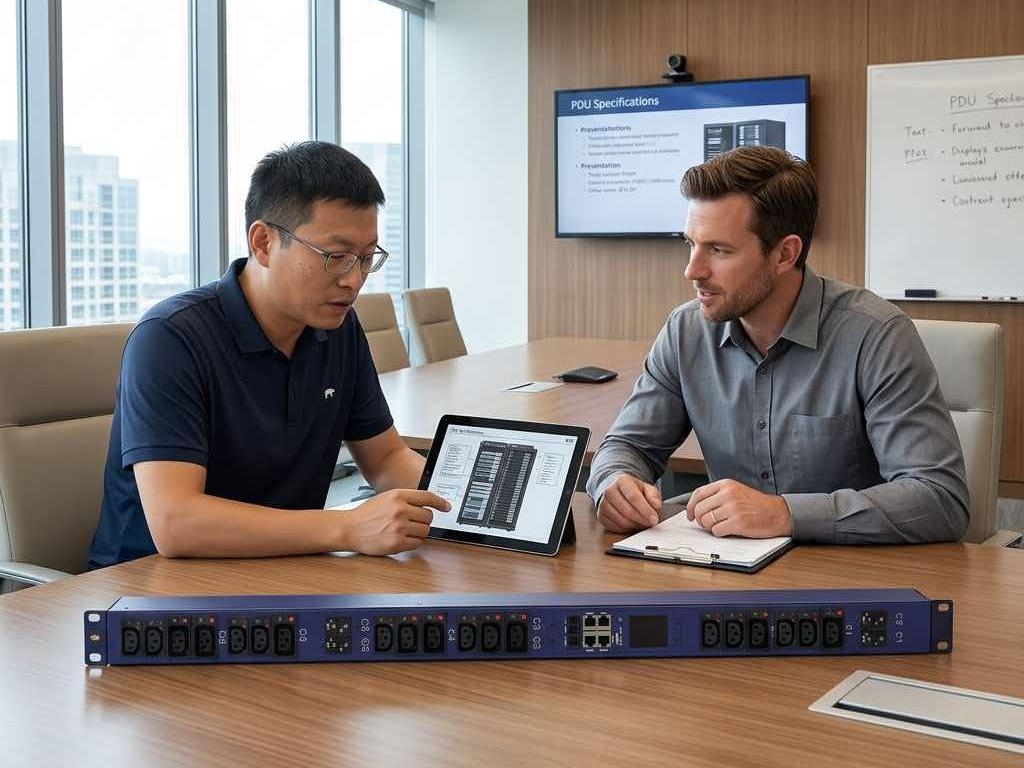
You send the rack spec, drawing or competitor part number.
→ We return a clarification list.

We check phase, load, input, outlets and protection.
→ 2D drawing and configuration sheet.

We build one or two units on the confirmed configuration.
→ Sample with test data, a few weeks.
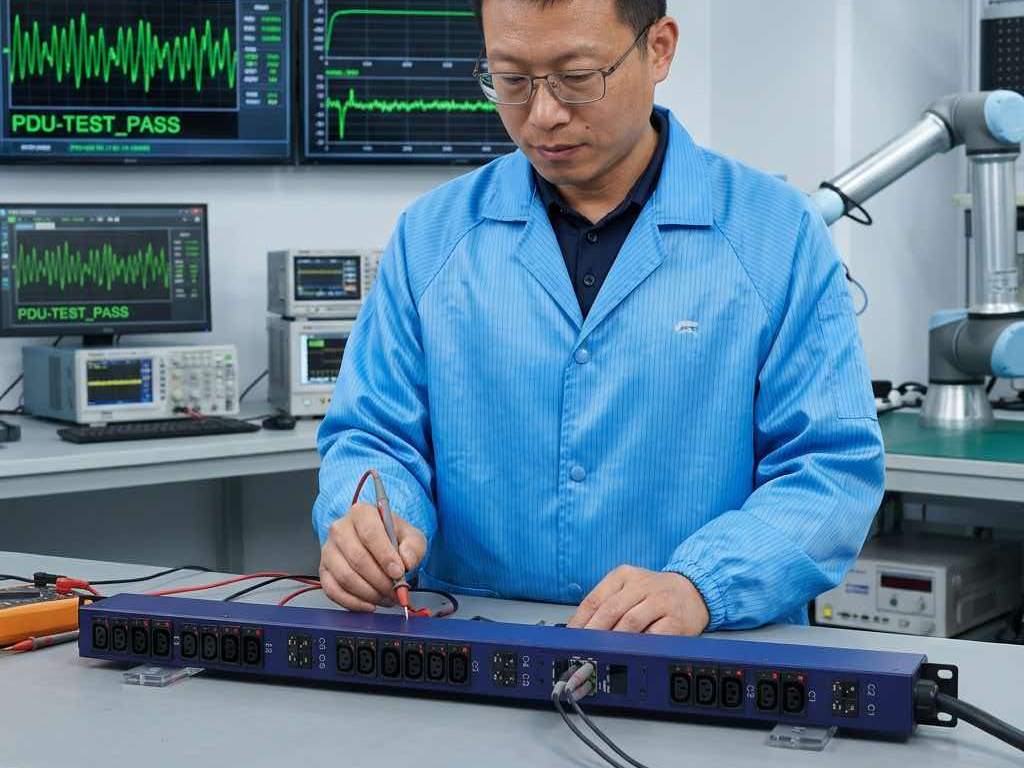
You approve the sample; we run the route for your market.
→ Certificate and DoC.

Bulk build with first-article inspection.
→ 30–45 days, with the document pack.
Send a spec sheet, a competitor part number, or a sketch.
A custom server rack PDU build is quoted within 24 hours, protection options included.
It takes one feed into the cabinet through an inlet, a breaker and rack-rated outlets. A power strip has no inlet rating and no branch protection, which is the part we build and test. We build the rack PDU range to the cabinet drawing.
Single phase covers a rack up to 3.68 kVA at 230V 16A, and three phase reaches 10.81 kVA at 208V 30A while balancing the load across conductors. We size from the rack load in kW, so the phase follows the number rather than the other way round. Our three phase PDU line runs 16A to 63A.
A local meter answers how loaded the rack is without any network behind it. We add remote reading with SNMP, Modbus or HTTP plus an alarm threshold when someone has to see the number without opening the door. Our metered PDU range covers the local tier, and per-inlet and per-outlet metering sit above it.
A switched unit opens and closes individual outlets from a browser or an API. We set power sequencing delays so equipment comes up in a set order and inrush does not trip the branch. The switched PDU range carries that control from 1U.
A 2U panel reaches 24 outlets, which covers a mixed C13 and C19 rack. Above that, panel area is the limit, so we move the count to a taller panel or a vertical strip. A 42-outlet high density PDU is the page for a full rack of 1U servers.
MOQ starts small on stock specifications and improves on project volume. We ship samples in weeks and bulk in 30 to 45 days, with aging and load tests before packing. A stock basic PDU is the fastest way to start.
Two cords need two strips on two feeds, one on A and one on B. Where only one feed is reliable, we add an ATS instead of a second feed. An ATS PDU is quoted with the pair, not after it.
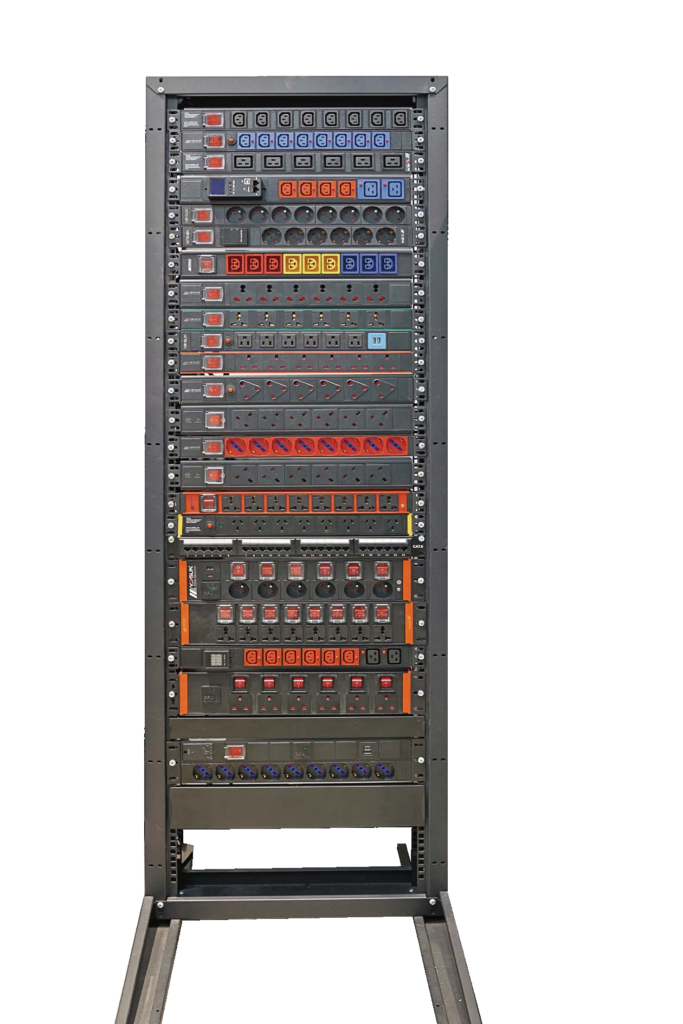
A Professional And Leading Manufacturer
For OEM
& ODM Power Distribution Unit (PDU)
You Can Trust
CONTACT
Ningbo YOSUN Electric Technology Co., LTD
Leading Professional Manufacturer in PDU Power Solutions
Contact Info.
Leave Your Message