Why Remote Monitored PDUs Are Essential for Data Centers
Remote monitored PDUs enhance data center efficiency by enabling real-time power monitoring, reducing energy waste, and ensuring operational reliability.

+86 15867381241
AI server racks now draw 30–100+ kW each — a level legacy data center power infrastructure was never engineered to support. This concentrated load requires fundamental upgrades to power distribution, not marginal adjustments. AI deployments that treat power as an afterthought will hit grid interconnection bottlenecks, suffer unplanned downtime, and face costly retrofits.
Three core shifts define the transition: exponentially higher rack density, evolved rack-level power delivery (including PDUs), and proactive grid and energy strategy to clear bottlenecks before they appear. Each carries direct cost, timeline, and operational implications for AI infrastructure planners.
AI hardware has pushed rack power density far above traditional data center baselines. Uptime Institute data puts average non-AI data center density at just 8 kW per rack in 2024. AI and GPU-accelerated racks now start at ~40 kW for common training clusters, and exceed 100 kW for purpose-built AI systems. Next-generation GPU racks are projected to reach 600 kW.
| Rack Category | Power Density (kW per rack) |
|---|---|
| Traditional enterprise racks | 5–10 kW |
| High-density threshold | >20 kW |
| Common AI / GPU racks | ~40 kW |
| Advanced AI training clusters | >80 kW |
| Purpose-built AI systems | >100 kW |
For context: racks built for H200 GPUs draw 40–50 kW each; B200 GPU racks reach ~130 kW. This means a single AI cabinet can consume as much power as an entire small server room from a decade ago.
This concentrated load creates stress across every layer of the power and facility stack:
The power delivery chain runs from utility substation to server inlet, and every stage must be sized for AI-level loads. A typical architecture has five stages:
GPU clusters are extremely sensitive to even momentary brownouts, making UPS sizing and redundancy critical. For rack-level distribution, busway offers prefabricated overhead power rails with tap-offs at any rack position — ideal for scalable high-density deployments. Remote power panels (RPPs) use fixed dedicated cabling, with lower upfront cost but less reconfiguration flexibility.
The gap between legacy and AI infrastructure drives every design decision:
| Upstream Requirement | Traditional Data Center | AI Data Center |
|---|---|---|
| Rack power density | 7–10 kW per rack | 30–100+ kW per rack |
| Workload pattern | Stable, predictable | Dynamic, bursty |
| Grid interface | Electromechanical loads | Power electronics converters |
| Typical facility scale | Moderate | 100 MW+ hyperscale |
AI workloads place unique demands on the chain: training jobs run at near-peak GPU utilization for days on end with zero tolerance for interruption, while inference workloads swing sharply with real-time demand. Staged distributed power conversion keeps losses and voltage drops low, with final conversion placed as close to the load as possible to handle fast load transients.
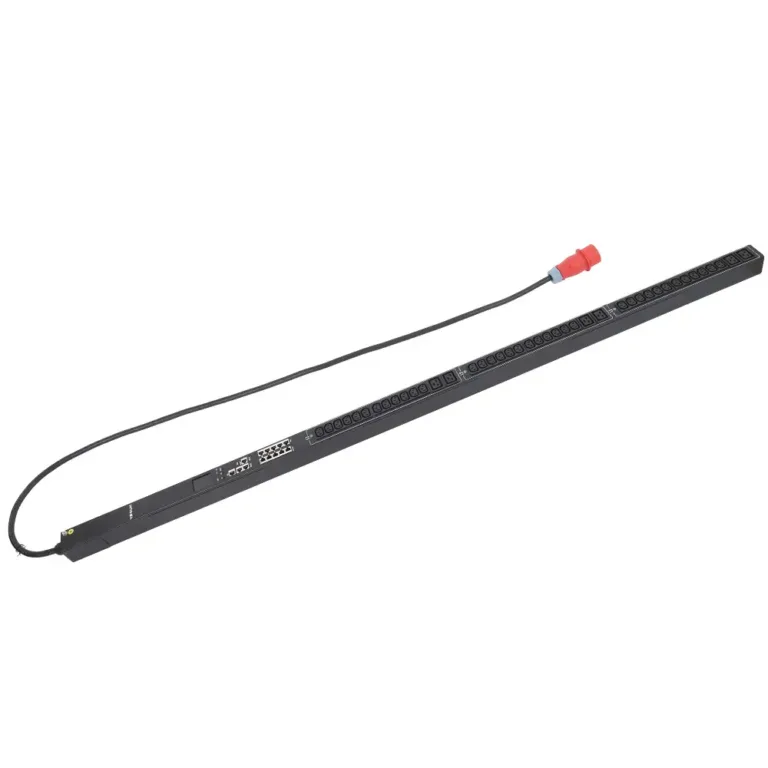
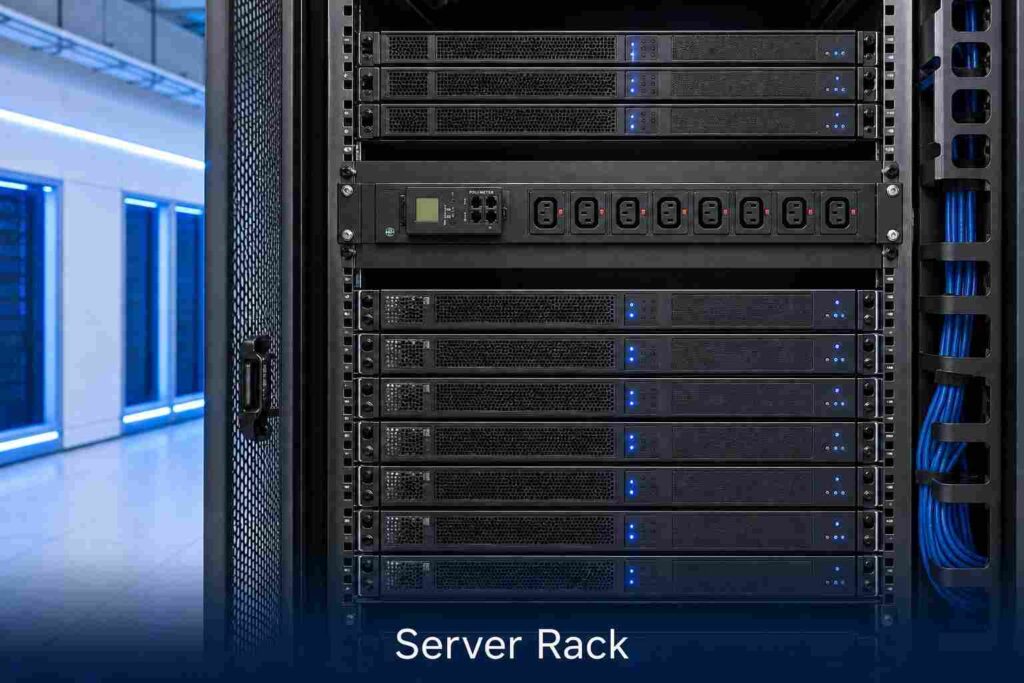
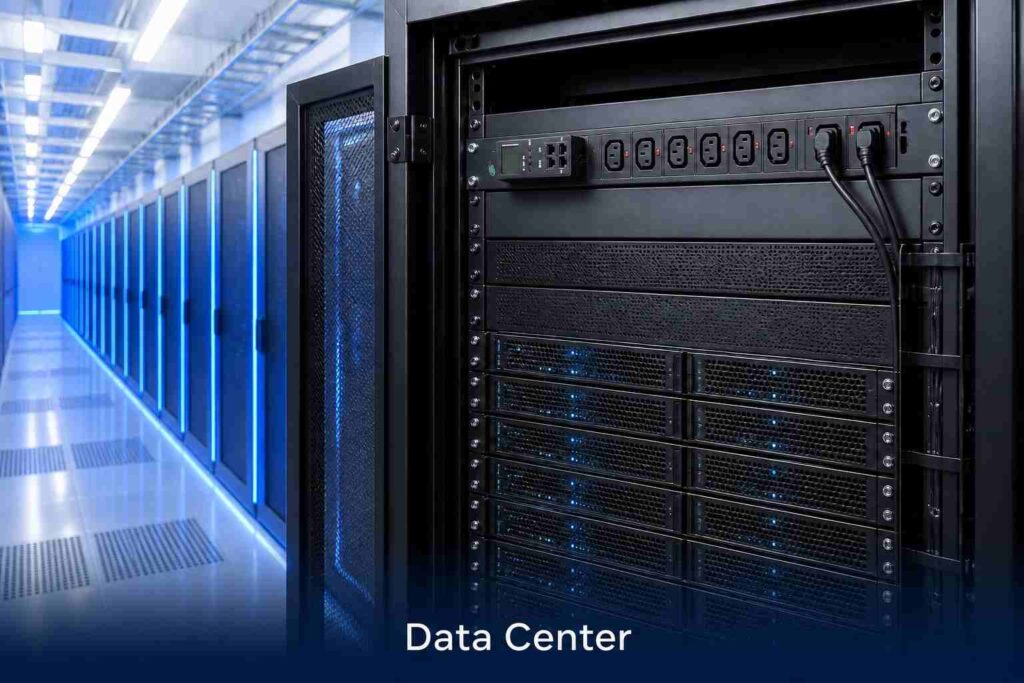
Rack PDUs are the final link in the power chain and the first point of failure visibility. With individual GPUs drawing 500–1,200 W each, and 8–16 GPUs per server chassis, modern GPU servers can pull 3–5 kW each during inference bursts.
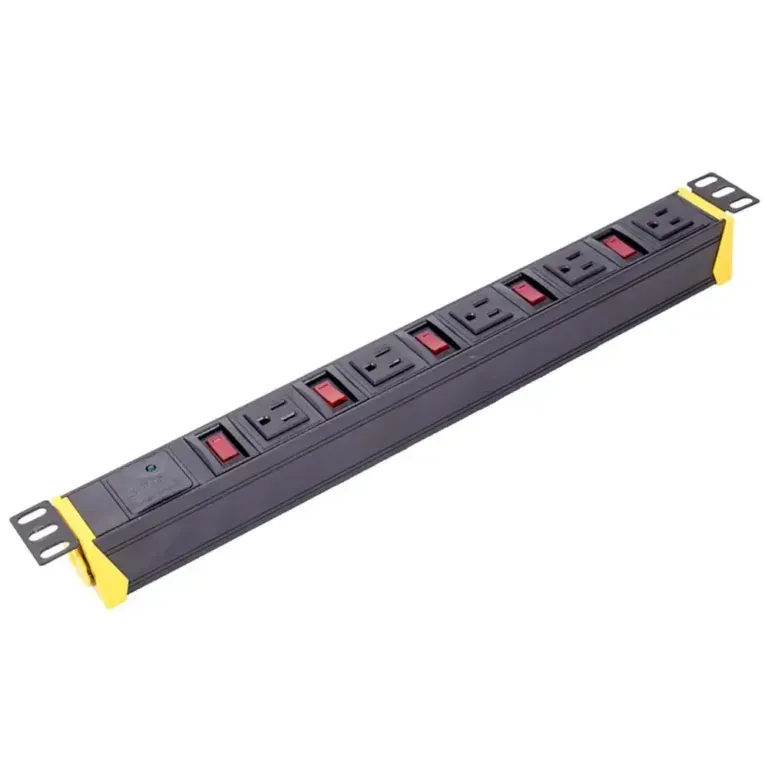
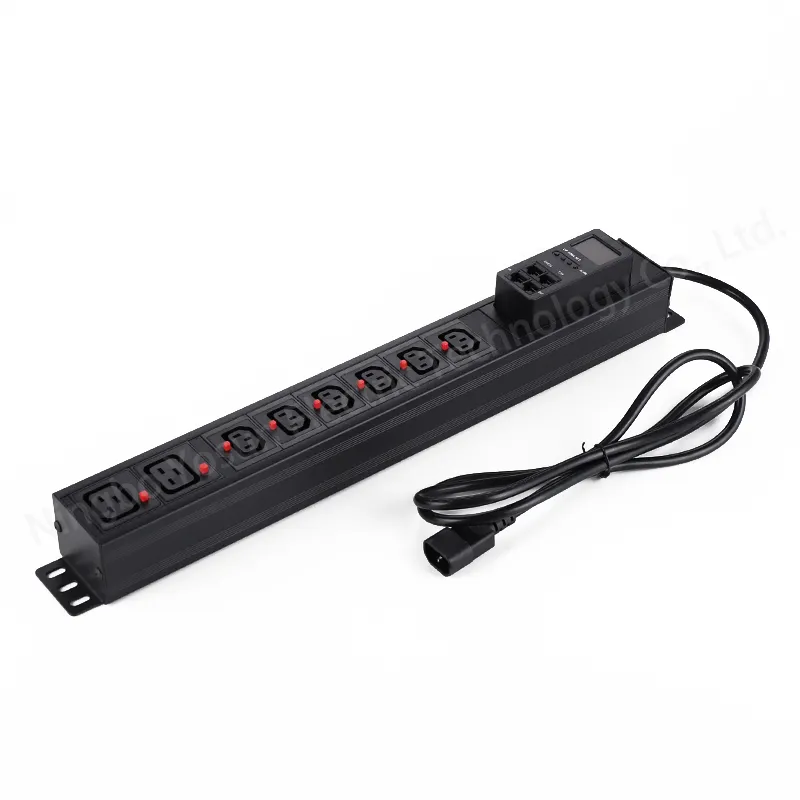
Per-circuit monitoring prevents silent breaker trips that can abort hours-long training runs. For 42U high-density AI racks, metered or smart three-phase PDUs in 0U vertical mounting are preferred over basic unmanaged units. Key selection criteria include input phase compatibility, mounting form factor, and per-outlet vs. inlet-only metering. Intelligent PDUs support SNMP/Modbus integration and include local displays or web interfaces for real-time current and voltage monitoring.
Three-phase power is a requirement for high-density AI racks, not an upgrade. For the same total power, three-phase distribution uses smaller, easier-to-manage conductors, reducing installation cost and complexity.
Unbalanced phase loading wastes capacity and creates dangerous overheating. PDUs with per-phase monitoring let operators detect imbalance and redistribute loads, improving efficiency and preventing thermal damage. AI racks often require three or more independent power paths to support 2N or 2N+1 redundancy architectures, beyond legacy dual A/B feed designs. Proper installation, labeling, and cable management preserve safety and maintainability.
The single biggest planning risk for AI deployments is the mismatch between data center construction timelines and grid interconnection lead times. Hyperscale data centers can be built in 18–24 months, but high-voltage transmission upgrades take 7–10 years. New utility service connections can take 5+ years to approve and build in many regions.
This gap requires proactive energy strategy, not reactive upgrades. Common mitigation strategies include:
Siting compute capacity closer to power infrastructure addresses the core timing mismatch: grid infrastructure takes 5–15 years to build, vs. 1–3 years for data centers. Proximity alone is not sufficient — a site near a wind farm may still require major network upgrades to deliver power reliably.
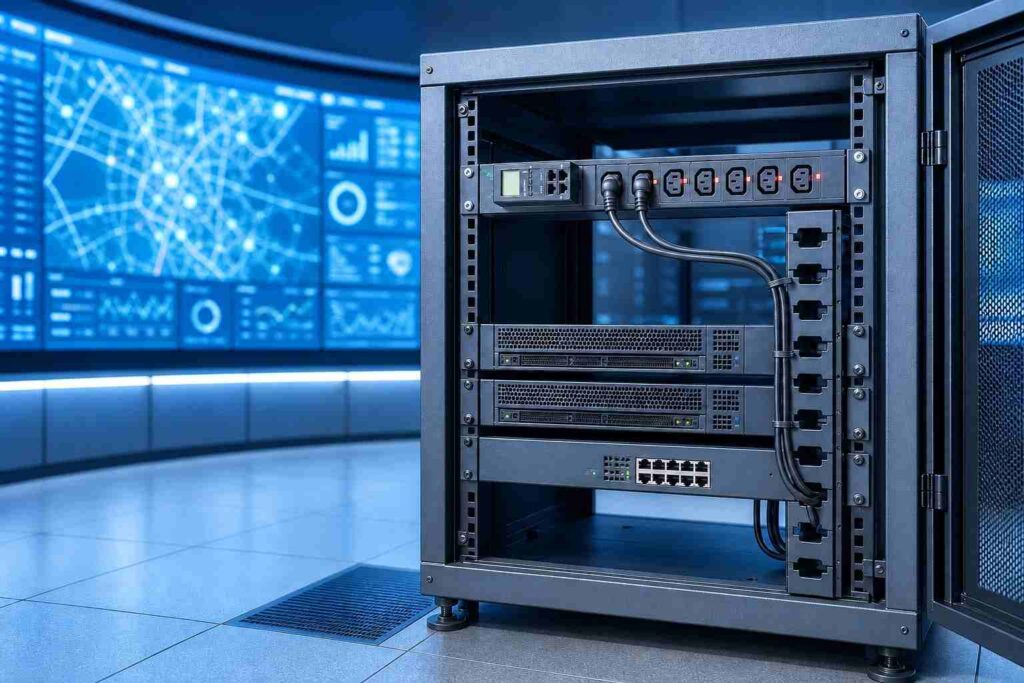
A structured PDU selection process follows five steps:
Voltage and current scale with density. Traditional 30A or 60A PDUs cannot support modern GPU servers. High-density AI PDUs must handle 100A+ with more branch circuit protection. Three-phase distribution lowers per-conductor current and reduces wiring stress. Higher distribution voltages also improve efficiency: server power supplies run ~3.5% more efficiently at 240V vs. 120V, a material difference at megawatt scale. Greenfield sites should evaluate 415V distribution for maximum efficiency; brownfield upgrades may find 480V more practical with existing infrastructure.
Three PDU tiers serve different roles in AI infrastructure:
| PDU Type | Key Features | Network Connectivity | Best Fit |
|---|---|---|---|
| Basic | Power distribution only | None | Low-density, stable-load cabinets |
| Metered | PDU-level voltage, current, and power metering | Optional on some models | Mixed-density colocation, secondary racks |
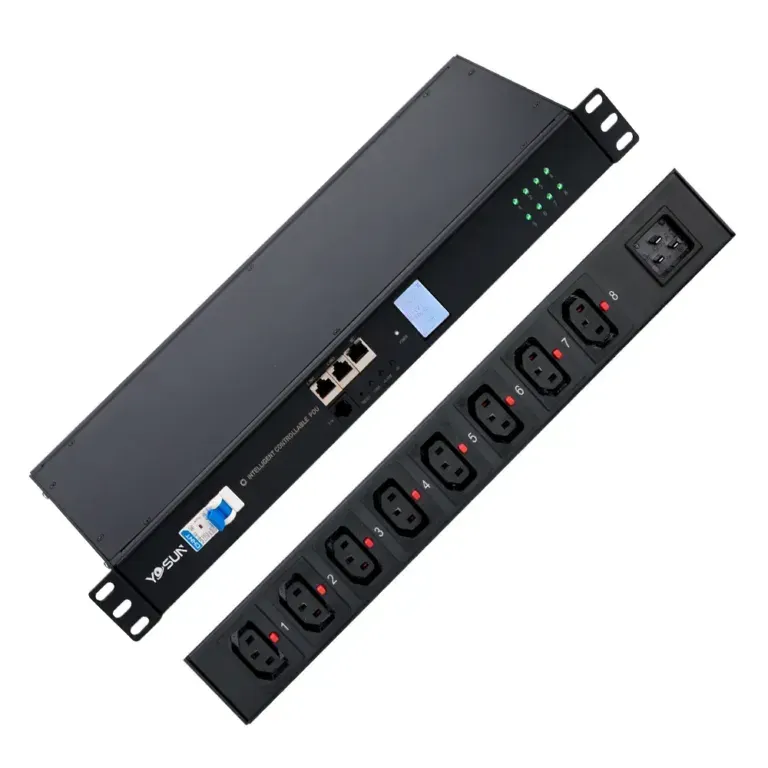
| Smart | Per-outlet monitoring & control, environmental sensors, analytics | Yes, multi-protocol support | High-density AI training racks, primary production |
Smart PDUs are the preferred choice for AI racks: outlet-level visibility lets operators catch overloads before they trip breakers, preventing costly training job interruptions.
Before finalizing PDU selection, confirm:
Plan for 30–100+ kW per rack for AI deployments, compared to 5–10 kW for traditional enterprise racks. Advanced training clusters already exceed 80 kW per rack, and purpose-built systems pass 100 kW. Always include headroom for next-generation GPU hardware to protect your investment.
Smart three-phase PDUs are the best fit for AI racks. They deliver per-outlet monitoring and control, plus environmental sensing. Metered units work for mixed-density colocation cabinets. Basic units are only suitable for low-density, stable loads. Evaluate options on technical fit, compliance, and total cost of ownership.
Grid interconnection lead times exceed 5 years in many regions. Data centers can be built in 18–24 months, while transmission upgrades take 7–10 years. Engage utilities early in the planning process, and evaluate proximity siting, on-site generation, or brownfield redevelopment to mitigate delays.
Unbalanced phases create stranded capacity and dangerous overheating. Per-phase monitoring lets technicians detect imbalance and redistribute loads. Redundant power paths plus balanced loads maximize uptime under heavy AI workloads. AI racks often require three or more independent power paths for full redundancy.
Confirm the 3–5 year load forecast, grid interconnection schedule, redundancy architecture, and PDU capacity headroom. Also verify DCIM/BMS integration and applicable compliance requirements. Align PDU decisions with broader hyperscale data center energy strategy for long-term alignment.