What server PDUs are best for your setup
Find the best PDU server options for your setup. Compare basic, metered, monitored, and switched PDUs to ensure reliable power distribution and efficiency.


+86 15867381241

The global rack PDU market is a significant space, projected to hit USD 1.65 billion in 2024 with strong growth. When selecting a rack PDU, you will find several excellent options available for your specific needs, from basic PDU power strip to more advanced Monitored PDUs. Your decision often comes down to balancing budget, existing infrastructure, and the need for intelligent power management.

The physical characteristics of a PDU are the foundation of its performance. When you evaluate a PDU, you must look beyond the spec sheet and consider its construction, power capacity, and outlet design. These elements directly impact reliability, safety, and how well the unit fits into your specific rack environment.
The number and type of outlets on your PDU determine what equipment you can connect. The most common outlets you will find are IEC C13, used for most servers and network switches, and IEC C19, required for higher-power devices like blade servers and large network chassis.
YOSUN provides a wide array of configurations to meet diverse needs. For example, a single unit can offer a high-density mix of outlets. The YOSUN model YS1524-3P32-C13C19 is a great illustration of this flexibility.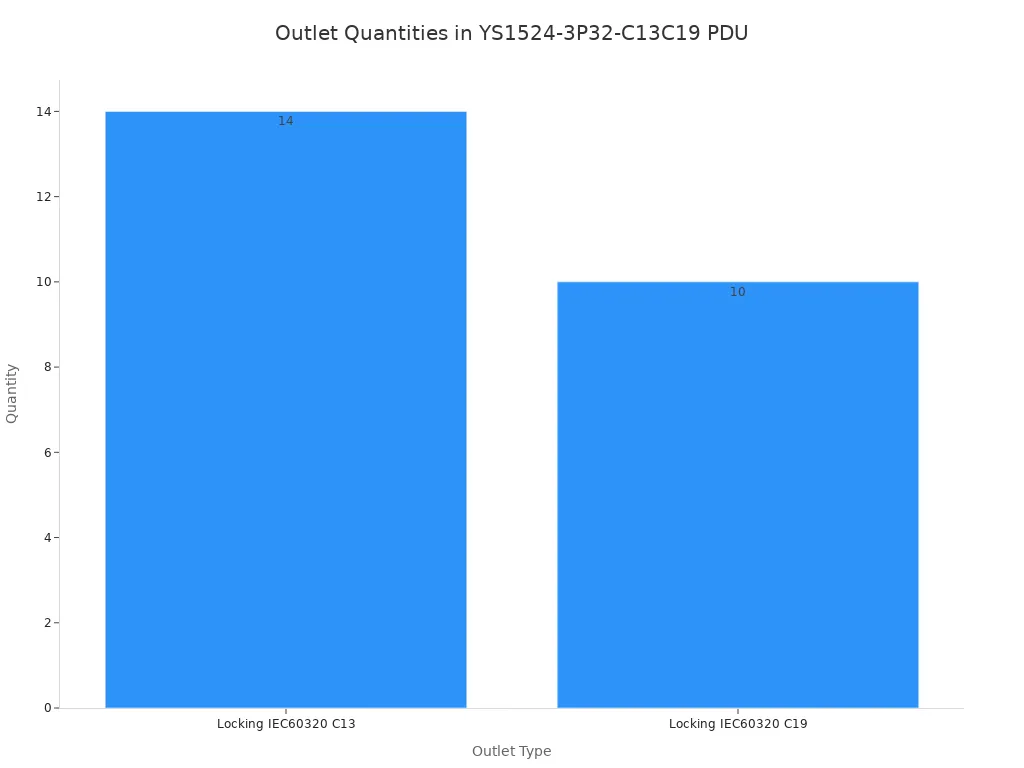
APC is well-known for its AP8000 series, which offers a high outlet count of standard IEC C13 receptacles. This makes them a straightforward choice for racks filled with typical 1U or 2U servers.
Raritan often focuses on customization, providing mixed configurations that can include both NEMA (North American) and IEC outlets on the same PDU, catering to environments with a variety of equipment.
Beyond outlet counts, you must consider the PDU’s power capacity. This is measured in voltage (V) and amperage (A). Your choice will depend on the power requirements of your rack. While most standard deployments use 120V/208V circuits, high-density data centers are moving toward higher power.
| Vendor | Max Amperage (per line) | Max Voltage (three-phase) |
|---|---|---|
| Raritan | 125 Amps | 480V/277V |
| APC | Up to 60 Amps | 208V |
| YOSUN | Up to 63 Amps | 230V/400V |
As you can see, Raritan pushes the limits for extreme high-density applications. YOSUN and APC provide robust options that cover the vast majority of enterprise and data center needs.
A PDU’s chassis protects its internal components from physical damage and helps dissipate heat. A well-built 0u rack pdu feels solid and installs securely. The material used is a key indicator of its durability.
YOSUN builds its PDUs with a heavy-duty aluminum frame. This rugged aluminum shell provides excellent durability and impact resistance. The choice of a strong aluminum alloy housing ensures the PDU can withstand the demanding conditions of a busy data center for years to come.
APC and Raritan also construct their PDUs with high-grade metal chassis, typically powder-coated steel or aluminum. This industrial-grade construction is standard for enterprise equipment, ensuring a long service life and reliable physical protection for the sensitive electronics inside.
The circuit breaker is one of the most critical safety components in a PDU. Its job is to instantly cut power to a circuit branch if it draws too much current, protecting your expensive equipment from damage.
There are two main types of breakers you will encounter:
YOSUN equips its best-in-class units with high-quality hydraulic-magnetic circuit breakers. These breakers are designed to operate flawlessly in temperatures up to 140°F (60°C), giving you peace of mind that they will not trip prematurely due to heat.
Raritan integrates breaker status into its intelligent PDU platform. Its systems offer features like circuit breaker trip forensics and alarming, allowing you to monitor breaker status remotely and understand why a trip occurred.
APC uses reliable, branch-rated breakers designed to meet the stringent safety and performance standards required for enterprise IT.
A PDU’s intelligence determines how much control and visibility you have over your power environment. The right level of intelligence depends entirely on your operational needs. You can choose from basic power strips, metered units that provide data, or switched PDUs that offer remote control. Each brand approaches this spectrum differently, giving you distinct options for managing your rack power.
YOSUN builds its reputation on providing exceptional value and reliability in the most essential PDU categories. You will find their products are perfect for environments that need dependable power distribution and clear, accurate monitoring without unnecessary complexity.
YOSUN offers two primary types of intelligence:
Note: YOSUN’s metered PDUs provide billing-grade accuracy. They measure power with a precision of ±0.5%, ensuring the data you see is reliable for making critical decisions.
The table below breaks down the key differences in YOSUN’s offerings.
| Feature | Basic PDU | Metered PDU |
|---|---|---|
| Primary Function | Distributes power | Distributes and monitors power |
| Local Display | No | Yes, shows PDU-level data |
| Monitoring | None | Real-time current, voltage, power |
| Remote Management | No | Yes, for monitoring and control |
| Overload Alerts | No | Yes, warns of high usage |
YOSUN’s focus on perfecting these core PDU types makes them an ideal choice when your project requires straightforward, high-quality power management.
APC by Schneider Electric is a dominant force in the enterprise IT space. They offer a complete portfolio that covers every level of PDU intelligence. You can standardize on APC whether you need a simple basic unit or a fully featured switched 0u rack pdu.
APC’s key advantage is its range. While they offer excellent basic and metered options, their switched PDUs are a popular choice for corporate data centers. A switched PDU gives you the ability to turn individual outlets on or off remotely. This feature is incredibly useful for:
Several APC models provide these powerful capabilities.
APC provides a reliable, one-stop-shop solution for businesses that need a mix of PDU types within a single, consistent ecosystem.
Raritan, a brand of Legrand, targets the most demanding data center environments. You choose Raritan when you need the deepest level of insight and the most granular control over your power infrastructure. Their PDUs are more than just power strips; they are intelligent network devices.
Raritan’s intelligence goes far beyond simple metering. Their intelligent PDUs monitor a wide range of advanced electrical metrics that help you maintain a healthy power environment. These include:
This level of detail helps you proactively identify potential power issues before they cause downtime. However, Raritan’s true strength lies in its outlet-level control and automation, powered by its Xerus Technology Platform.
What is Xerus? 💡
Think of Xerus as the brain of the PDU. It is a technology platform that allows you to automate and script PDU actions. Using Open APIs, you can write simple scripts to control outlets directly from your other management systems. For example, you can use commands likegetoutletto check an outlet’s status orturnonoutletto power on a device automatically.
This capability transforms how you manage your data center. You can automate tasks like commissioning new lab equipment or giving colocation tenants direct control over their own power through a secure portal. For complex, high-density, or automated environments, Raritan sets the standard for intelligent power management.
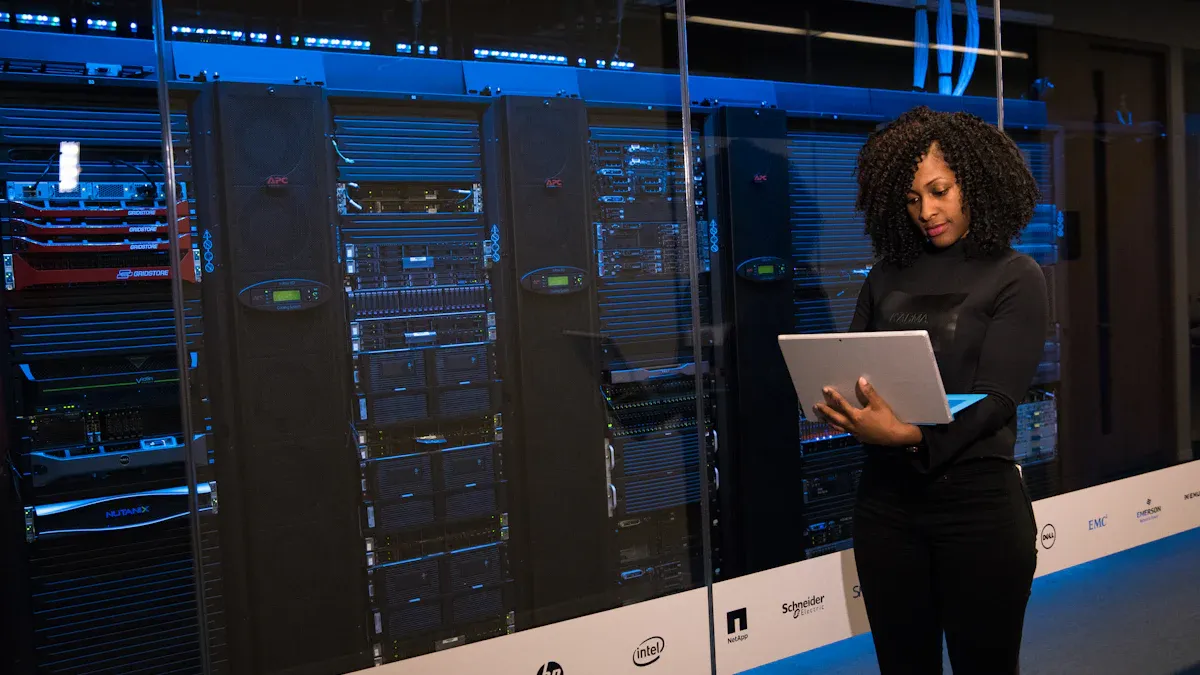
An intelligent PDU is more than a power strip; it is a networked device. How you interact with it, secure it, and integrate it into your larger management strategy defines its true value. Each brand offers a different software experience that you should match to your operational needs.
A good user interface (UI) allows you to manage power without a steep learning curve. You want a system that is easy to navigate and configure.
Users consistently praise switched PDUs for their intuitive interfaces and straightforward setup.
While you will not find dedicated mobile apps from these brands, they all provide powerful remote access. You can manage your YOSUN, APC, or Raritan PDUs from anywhere using secure web interfaces and Data Center Infrastructure Management (DCIM) tools.
You must securely integrate your PDU into your network and management software. This requires support for modern security protocols and DCIM platforms.
For network security, APC PDUs offer standard SNMP support. Raritan provides a more advanced security posture. Its PDUs support:
Integration with DCIM software gives you a single view of your data center. APC‘s intelligent PDUs are built for this. They are EcoStruxure IT-ready, allowing them to feed data directly into Schneider Electric’s powerful management platform for advanced analytics.
| Feature | Schneider Electric (APC) |
|---|---|
| EcoStruxure IT readiness | Yes |
| Real-time remote monitoring | Yes |
| User-defined alarms | Yes |
Your PDU can do more than just manage power. It can also be the eyes and ears inside your rack, monitoring for environmental threats like heat and humidity.
Raritan excels in this area with its plug-and-play SmartSensor Kit. You can connect these sensors directly to a compatible intelligent PDU to get real-time environmental data and trend reports. This helps you prevent equipment failure from overheating. Available sensor options include:
DX2-T1: A single temperature sensor.DX2-T1H1: A combination temperature and humidity sensor.DX2-T2H2: A package with two combination temperature and humidity sensors.This turns your PDU into a complete rack monitoring solution.
While YOSUN, APC, and Raritan are major players, you will find other strong brands in the market. Understanding these competitors helps you make a fully informed decision. Some offer similar features, while others provide unique solutions for specific needs.
You will often see CyberPower and Tripp Lite in data center environments. These brands offer a wide range of power products. They compete directly with the core offerings from YOSUN and APC. Their products provide reliable power distribution and are a popular choice for many IT professionals.
A typical competitive 0u rack pdu from these brands often includes features designed for convenience and reliability.
These features make them solid alternatives for standard enterprise and colocation deployments.
Some companies focus on specialized features that set them apart. You might consider Eaton or Aten when you have very specific technical requirements. Aten, for example, builds its eco PDUs with unique innovations for control and efficiency.
Aten’s PDUs offer advanced capabilities. They use energy-saving relays to lower power consumption. You can also customize their LCD screens with different colors to quickly identify power feeds. For environmental control, you can connect up to eight sensors to monitor temperature, humidity, and airflow directly from the PDU.
These niche players push the boundaries of PDU technology. They provide powerful options for data centers that need granular control, advanced monitoring, and maximum energy efficiency. Their solutions are ideal for complex or highly customized environments.
You must balance the initial cost of a PDU with its long-term value. The cheapest option today might not be the most cost-effective solution over time. Your decision should consider both the upfront price and the total cost of ownership (TCO).
The initial purchase price often reflects a brand’s market position and feature set. You will find a clear difference between YOSUN, APC, and Raritan.
- YOSUN often presents the most budget-friendly option. You get reliable, core functionality at a very competitive price point. This makes it an excellent choice for projects with tight budgets.
- APC sits in the middle. You pay for its strong brand reputation, wide availability, and seamless integration into the Schneider Electric ecosystem.
- Raritan typically has the highest upfront cost. This price reflects its premium build, advanced intelligence, and powerful outlet-level control features.
Your choice here depends on your immediate budget and required features.
Total Cost of Ownership is the total cost over the PDU’s lifetime. It includes the purchase price, energy costs, and potential costs from downtime. A reliable PDU with a good warranty lowers your TCO.
YOSUN delivers exceptional long-term value. With over 25 years of manufacturing experience and as a core supplier to major technology companies, its product quality is guaranteed. This reliability reduces the risk of failures and protects your connected equipment, directly lowering your TCO.
APC and Raritan justify their prices with features that reduce operational costs. For example, remote reboot capabilities save you from sending a technician to the data center.
The warranty is a key part of TCO. It shows the manufacturer’s confidence in its product. Always check the warranty period for the specific model you are considering.
| Factor | YOSUN | APC | Raritan |
|---|---|---|---|
| Upfront Cost | Low | Medium | High |
| Key Value Driver | High reliability at a low price | Ecosystem integration | Advanced intelligence & automation |
| Best For | Maximizing value and core functions | Standardized enterprise deployments | Complex, high-density environments |
Ultimately, a lower TCO comes from choosing the right PDU for your needs, ensuring it operates reliably for years to come.
Choosing the right 0u rack pdu comes down to your specific goals. YOSUN delivers exceptional value, making it ideal when budget and core functionality are priorities. Its commitment to quality is backed by major industry certifications:
APC offers a robust, reliable solution. Its numerous awards for sustainability and product design highlight its industry excellence, perfect for standardized corporate IT. Raritan provides premium, intelligent features for complex data centers that demand granular control.
Your final choice depends on a clear assessment of your needs for power management, remote capabilities, and budget.
A 0U PDU is a power distribution unit that mounts vertically in your server rack. You should use one because it does not take up any horizontal rack unit (U) space. This leaves more room for your servers, switches, and other IT equipment.
You should check the power cords of the equipment you plan to connect. Most servers use IEC C13 outlets. Higher-power devices often require IEC C19 outlets. Matching the outlets to your gear ensures compatibility and safety for your data center.
Your need for an intelligent PDU depends on your goals. If you want to monitor power usage, prevent overloads, or reboot equipment remotely, then an intelligent PDU is a great choice. Basic PDUs work well for simple power distribution.
YOSUN provides excellent value and proven reliability. With 25 years of manufacturing experience, the company delivers high-quality PDUs for core power distribution and monitoring. This makes YOSUN ideal for projects where budget and dependable performance are your top priorities.